A reliable RAG chatbot architecture allows your company to use artificial intelligence safely without exposing sensitive client files or guessing facts. Standard public AI tools often answer questions with confidence even when they do not know the truth. For a small business handling client contracts, payroll questions, or technical specifications, an invented answer can cause severe financial and legal problems.
Building a dedicated RAG chatbot architecture means your customer service tools and internal assistants read only your approved files. Retrieval-Augmented Generation (RAG) was formally introduced in a 2020 paper demonstrating how a parametric language model couples with non-parametric external memory queried at inference time. Instead of relying on what a large model memorised during public training, your system searches your private documents first and writes responses using only those extracts. A proper setup ensures these lookups remain completely accurate.
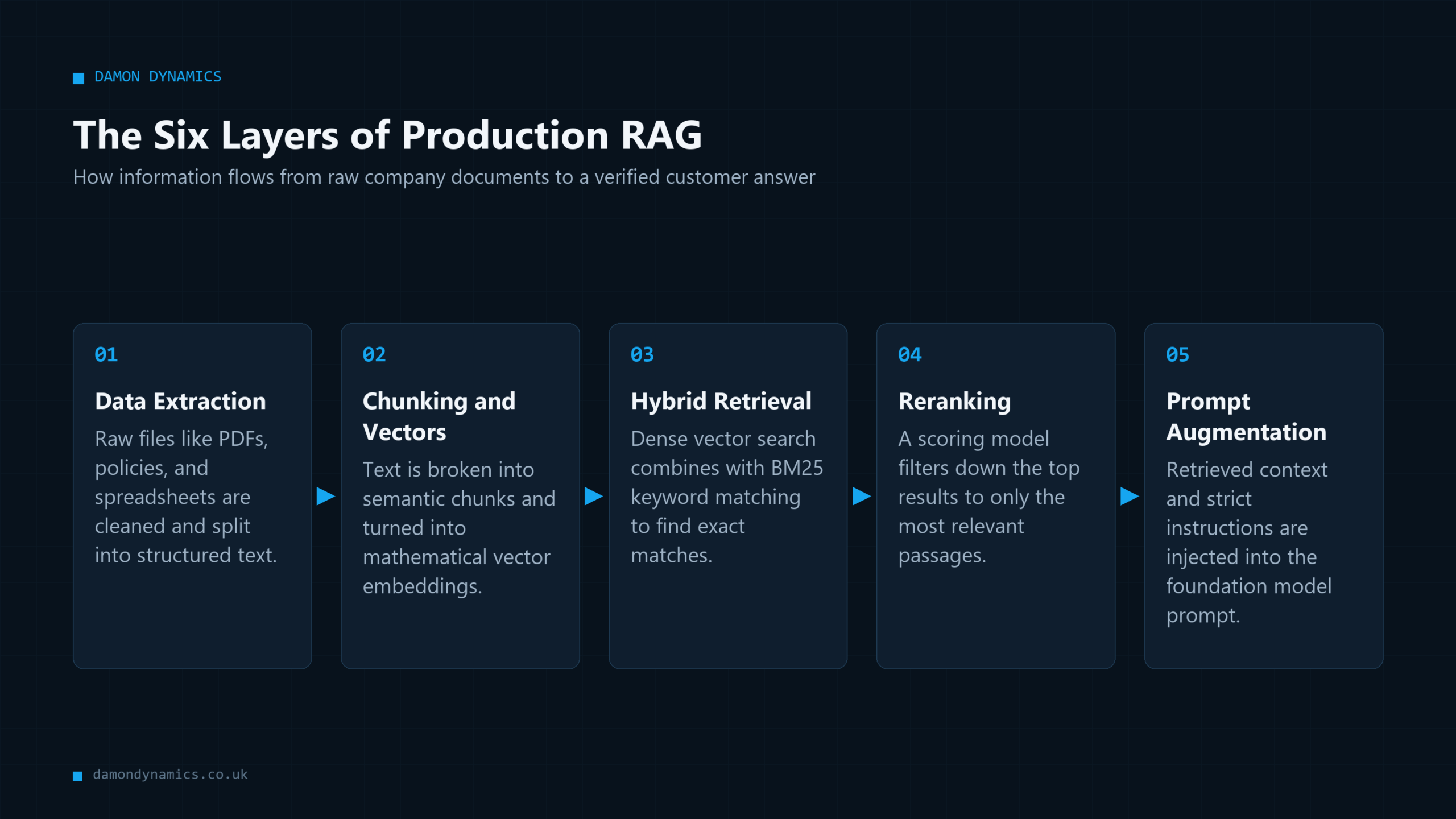
In this practical technical guide, we break down how a modern RAG chatbot architecture works from raw data ingestion to exact page citations. You will see how clean chunking, hybrid vector search, and reranking stop AI errors before they reach your customers.
Table of Contents
Why UK Small Businesses Need a RAG chatbot architecture
Off-the-shelf generative tools are trained on broad public internet data. They know general facts, but they know nothing about your pricing tiers, staff leave policies, or specific client service agreements. When asked a precise operational question, an ungrounded model will often invent dates, statutory rates, or terms that sound plausible but are entirely fictional.
A custom RAG chatbot architecture solves this problem by separating knowledge storage from language processing. Your private business records stay securely stored in your own databases. When a user asks a question, the system searches your library for the relevant text snippets and hands them to the language model as temporary reference material.
In addition to reducing hallucinations, RAG allows LLMs to cite sources directly in responses so users can verify factual accuracy. If your system cannot find the exact answer in your source documentation, the RAG chatbot architecture instructs the model to state clearly that it does not know. This single boundary protects your business reputation and saves staff from correcting false customer promises.
Before committing funds to development, you may want to check our detailed breakdown of AI chatbot cost in the UK to understand ongoing maintenance and hosting figures.
RAG chatbot architecture: layer 1: Document Ingestion and Chunking Strategies
The first layer of any information pipeline is data processing. Real business documents rarely arrive as clean, uniform plain text files. Your company relies on scanned PDF invoices, Word contracts, spreadsheets, intranet articles, and email threads. The system must ingest these files systematically without losing formatting.
Before an algorithm can search these records, the system must parse each file format correctly. Scanned PDFs need reliable text extraction, tables must retain their column headers, and markdown files need metadata tags like document titles and update dates.
Once extracted, the text must be divided into smaller sections called chunks. If a chunk is too long, the system introduces irrelevant filler text that distracts the AI. If a chunk is too short, important context disappears, such as which client a specific paragraph applies to.
Most small business systems use fixed-size chunks of 300 to 500 words, combined with a 10% to 20% overlap. This overlap ensures that sentences crossing boundary lines are not split in half. For complex corporate manuals, semantic chunking is better. Semantic chunking splits text on headings, natural topic shifts, or markdown sections so each chunk represents one coherent concept.
“` +————————————————————-+ | Raw Documents (PDF, DOCX, CSV, Intranet) | +————————————————————-+ | v +————————————————————-+ | Layer 1: Text Extraction & Metadata Tagging | | – Parse layout, preserve tables | | – Semantic chunking (300 to 500 words with overlap) | +————————————————————-+ “`
Layer 2: Vector Embeddings and Vector Databases
Once text is split into chunks, the retrieval framework converts those written words into mathematical vectors. A vector is a long list of numbers representing the underlying meaning of the text. Sentences with similar meanings produce vectors that sit close to each other in mathematical space, even if they use completely different vocabulary.
For example, the phrases “how much maternity pay do staff receive?” and “parental leave remuneration rates” will generate very similar vectors. This semantic understanding lets your staff query internal files using natural language rather than guessing exact keyword matches.
These numerical vectors are stored in a specialised vector database alongside the original text snippets and metadata tags. Common vector engines include open-source self-hosted options like Qdrant, Milvus, and pgvector, as well as managed cloud solutions like Pinecone.
A secure RAG chatbot architecture stores document access control tags directly alongside these vectors. When a team member runs a search, the database pre-filters the records. A junior staff member querying an internal RAG chatbot will never retrieve vectors created from executive payroll spreadsheets or sensitive director minutes.
Layer 3: Hybrid Search in a RAG chatbot architecture
Relying entirely on vector similarity can lead to surprising search failures in a commercial setting. Vector models excel at understanding general meaning, but they often struggle with exact product codes, legal reference numbers, chemical names, or UK postcodes.
If a customer asks your chatbot about part number “ZX-402-B”, a pure vector search might return results for “ZX-401” or general product manuals because the numbers feel mathematically interchangeable. To avoid this, a well-built system implements hybrid retrieval.
Production RAG architectures combine dense vector search with BM25 keyword matching via Reciprocal Rank Fusion (RRF) to eliminate false negatives caused by domain-specific jargon or technical error codes. BM25 is an industry-standard statistical keyword search algorithm. It scans for the exact letters and numbers within your chunks.
The system runs both searches at the same time: 1. Dense vector search retrieves passages that match the conceptual meaning of the question. 2. BM25 search retrieves passages containing the exact terms, names, and part numbers. 3. Reciprocal Rank Fusion blends the two lists into a single ranked score, bringing documents that appear in both lists straight to the top.
A balanced design ensures that whether a user asks a high-level conceptual question or quotes a hyper-specific contract clause, the retrieval system finds the right page.
Layer 4: Context Reranking for Precision
Finding the top twenty matching chunks from your vector database is only half the battle. Passing twenty long chunks to a language model is expensive, slows down response speeds, and causes a known issue called “lost in the middle”. Large language models often pay close attention to the beginning and end of their input prompt while ignoring text buried in the middle.
To maintain speed and factual precision, a mature system uses a dedicated reranking model. While vector databases use fast, approximate mathematical checks to shortlist candidates, a cross-encoder reranker performs a deep comparison between the user query and each shortlisted passage.
The reranker scores each chunk on a scale from zero to one based on direct relevance. The system then discards low-scoring passages and sends only the top three to five purest chunks to the generation layer.
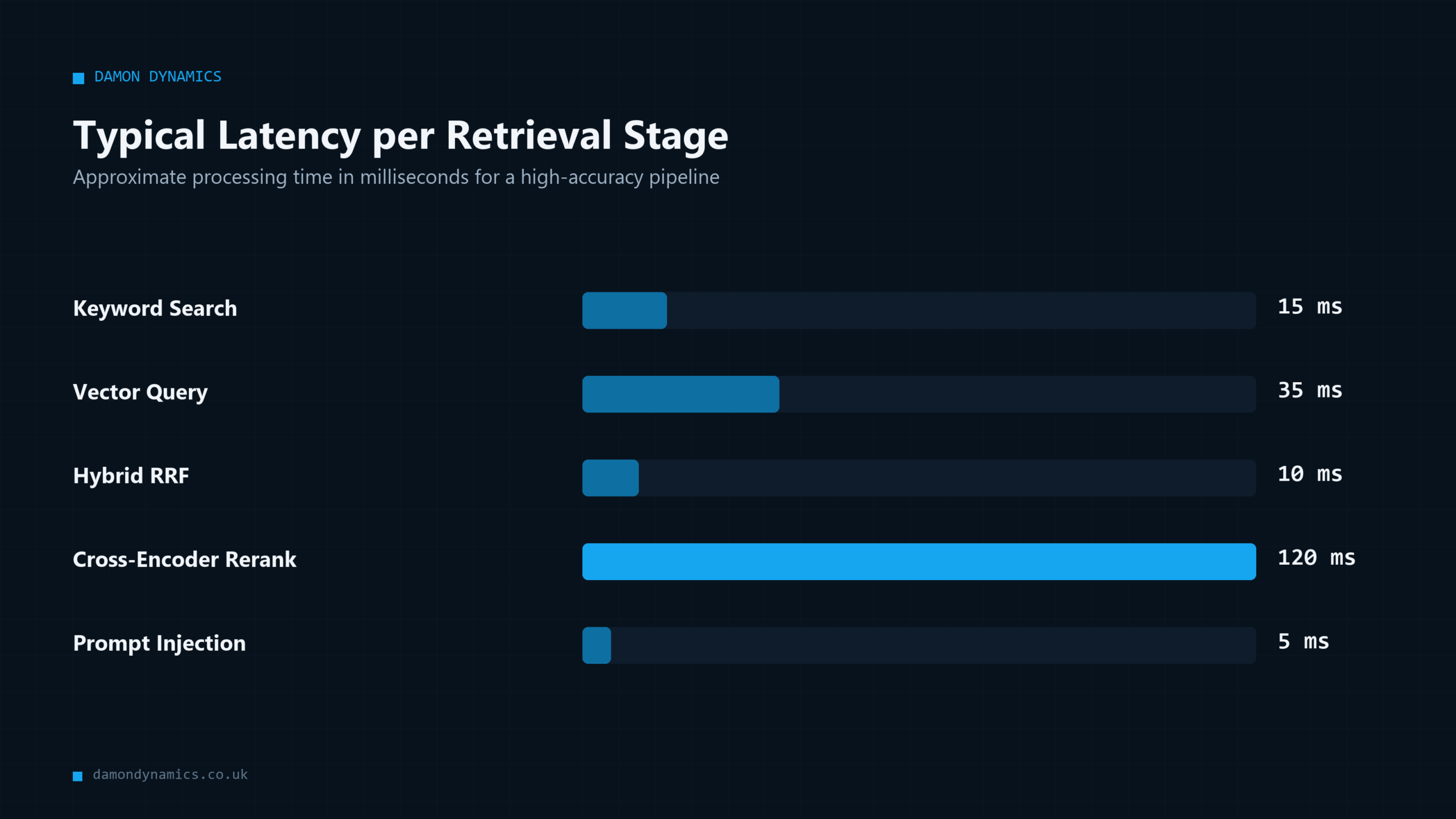
| Component | Primary Function | Typical Latency | Cost Factor |
|---|---|---|---|
| Document Parser | Converts PDF, DOCX, and tables into plain markdown | Batch (offline) | Low |
| Embedding Model | Converts text chunks into mathematical vectors | 20 to 50 ms | Low |
| Vector Database | Stores vectors and runs approximate nearest-neighbour search | 10 to 40 ms | Low to Medium |
| BM25 Engine | Indexes exact tokens for code, date, and name lookup | 5 to 20 ms | Very Low |
| Cross-Encoder Reranker | Scores shortlisted passages against the exact query | 80 to 150 ms | Medium |
| LLM Generator | Reads top chunks and drafts the cited answer | 800 to 2,500 ms | Variable per token |
This two-stage retrieval structure keeps your ongoing API costs down. It also ensures that the language model only reads chunks that contain the precise facts needed to answer the question.
Layer 5: Generation and Fusion Strategies
Once the reranker selects the most accurate snippets, the pipeline moves to the generation phase. This is where the chosen snippets merge with the user’s initial question to form an augmented prompt.
A production RAG pipeline consists of nine core architectural components, ranging from external knowledge sources and chunking to vector databases, prompt augmentation, and an optional updater. At the generation stage, system prompts act as strict guardrails. The prompt tells the language model:
“You are an internal business assistant. Answer the user question using ONLY the provided document extracts. If the extracts do not contain the answer, say clearly that you do not know. Do not guess or extrapolate.”
The technical pipeline must also decide how retrieval data merges with the model. In RAG architectures, generative fusion can occur at decoding time (Fusion-in-Decoder), keeping retrieval and generation separate for higher-quality output, or at encoding time (Fusion-in-Encoder) for faster processing.
For the vast majority of small and medium UK businesses, using Fusion-in-Decoder over standard modern APIs provides the highest text quality and the most dependable citation tracking. A properly configured pipeline keeps the original source text completely visible to your inspection logs, making audits straightforward.
If you are exploring how automated tools can assist internal operations alongside customer chat, read our guide on AI automation for small business to see where software pipelines deliver immediate value.
Layer 6: Citations, Verification, and Guardrails
The final layer of a resilient RAG chatbot architecture is verification and output formatting. An AI chatbot that claims something without showing its working is difficult to trust in a commercial environment. Every answer should feature clickable citations or document references.
When the language model constructs its response, it references the metadata carried over from the ingestion layer. If the model quotes a paragraph from your company health and safety policy, it appends a footnote pointing directly to “Health_Safety_Policy_2026.pdf, Page 14”.
In addition to source links, modern pipelines use output guardrail checks. A lightweight secondary process checks the model’s drafted response against the retrieved source chunks before the message renders on the user’s screen. If the drafted text makes a claim that is unsupported by the context chunks, the validation engine intercepts the response and flags it for human review.
This closing layer provides the peace of mind required when deploying an AI assistant for small business. Staff members and clients can independently verify facts in two seconds by clicking the cited document link.
Common System Pitfalls and How to Avoid Them
Building an operational RAG chatbot architecture involves navigating several practical hurdles. Many businesses launch a basic proof-of-concept using standard online tutorials, only to find it breaks down when real staff ask everyday questions.
Here are four common engineering mistakes and their practical fixes:
- Chunking without context headers: If you slice a 50-page document into raw 400-word blocks, the paragraph describing “Eligibility Criteria” loses the document title telling the system which service it refers to. Fix this by prepending the document title and section hierarchy to the top of every chunk before embedding it.
- Ignoring table data structures: Standard text extractors often read tables left-to-right across rows, turning structured financial figures into jumbled nonsense. Use specialized parsers that convert tables into clean markdown format so the model understands column relationships.
- Overlooking document obsolescence: If your database contains both your 2024 pricing spreadsheet and your 2026 update, a vector search might retrieve both. The language model might quote outdated rates. Ensure your system includes an active document lifecycle status that deletes or downgrades expired records.
- Skipping keyword search: Relying entirely on dense vector search means users cannot reliably look up unique part numbers, email addresses, or statutory codes. Always pair vector search with a BM25 keyword index in any RAG system.
Data Privacy, Security, and UK GDPR Compliance
Data security is a non-negotiable requirement when deploying a RAG chatbot architecture on proprietary business data. Many business leaders worry that uploading internal files to an AI platform means their company data will be used to train public foundation models.
When properly engineered, this does not happen. Professional enterprise API tiers from major foundation model providers include explicit legal clauses stating that customer inputs and outputs are not used for model training. Furthermore, your primary knowledge base remains securely inside your own cloud infrastructure, whether hosted in UK data centres or within private virtual networks.
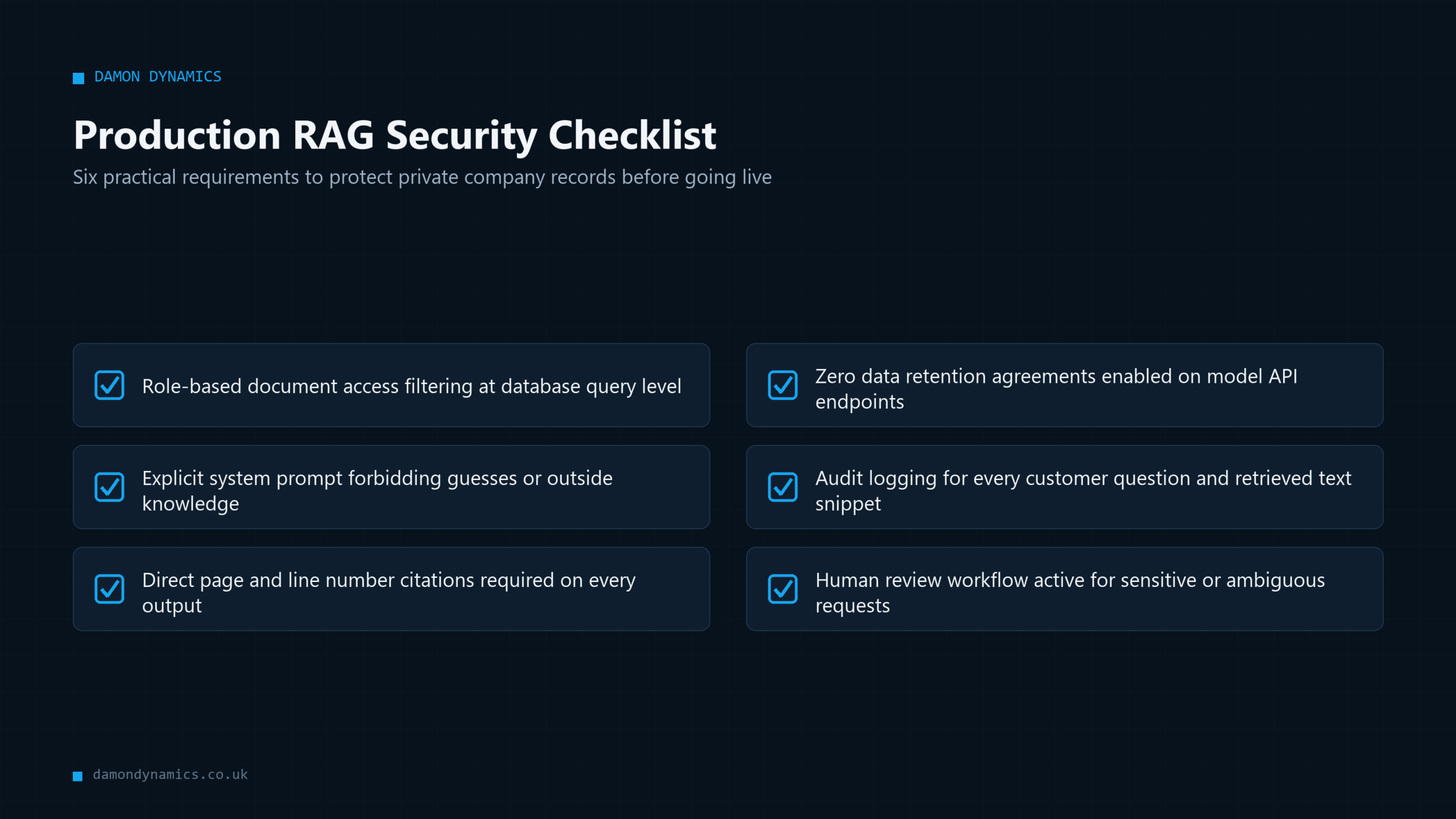
To comply fully with UK GDPR when handling confidential records in a RAG chatbot architecture: – Remove unnecessary personal identifiers like National Insurance numbers or personal addresses during the Layer 1 ingestion stage. – Enforce strict role-based access control (RBAC). The search layer must verify the user’s permissions before returning retrieved document chunks to the prompt. – Set zero data retention parameters on model APIs so external servers discard prompt text immediately after generating the response. – Maintain a full audit log detailing who asked each query, what text chunks were retrieved, and what answer was returned.
Keeping your customer data safe requires rigorous engineering, not guesswork. You can read our outreach privacy notice to see how we approach data governance and statutory transparency across all our projects.
When Retrieval Systems Are Not the Answer
While a RAG chatbot architecture is exceptionally useful for answering questions based on large document libraries, it is not the right technical tool for every operational problem.
If your primary business requirement involves performing complex mathematical calculations, live transactional stock checks, or multi-step database updates, standard document retrieval will let you down. Language models are probabilistic text prediction engines. They are not deterministic calculation engines. In a standard RAG chatbot, asking a conversational model to calculate compound interest across a customer portfolio can lead to arithmetic errors even if it reads the correct formula from a PDF.
Similarly, if your business operations require pulling live, structured data from external suppliers or public sites, you might need a dedicated real-time data scraper rather than a RAG chatbot architecture. For instance, our technical overview on AI price tracking in the UK explains how targeted extraction pipelines collect structured market figures more reliably than conversational bots.
For straightforward transactional workflows, such as booking an appointment into a calendar or sending a standardized invoice receipt, traditional deterministic code or standard web automation is faster, cheaper, and entirely error-free. A dedicated RAG chatbot architecture should be reserved for unstructured, text-heavy knowledge tasks where human-like language synthesis and semantic retrieval deliver real time savings.
How Damon Dynamics Builds Production RAG Systems
Damon Dynamics is an AI engineering company based in Bradford, West Yorkshire. We design, build, and deploy production software for businesses across Yorkshire, including Leeds, Halifax, Huddersfield, Wakefield, and Keighley, as well as companies remotely across the UK.
Every project is built directly by Damon, who holds an MSc in Artificial Intelligence and Data Science from the University of Hull. When you work with us, there are no junior account managers or outsourced developer handoffs. You talk straight to the engineer who writes the code and designs your custom RAG chatbot architecture.
We do not believe in speculative monthly retainers or unpredictable open-ended day rates. We work through a transparent, disciplined process:
- Free 30-Minute Discovery Call: We examine your document workflows and establish whether a custom RAG chatbot architecture is genuinely the most cost-effective solution for your problem.
- Fixed Written Quote: You receive an all-inclusive specification with clear technical boundaries and fixed pricing before any work begins on your project.
- One Workflow First: We prove ROI by building a single, high-value pipeline first, such as an internal policy search engine or a technical support assistant.
- Human-in-the-Loop Controls: Any customer-facing message or critical business output includes human verification stages to keep risk at zero.
- Full Handover and No Lock-in: We document every component, hand over the source code, and set up your databases so you own your assets completely.
We apply these exact engineering standards to our own live products. Our platform Plainly Benefits uses this approach to answer complex PIP and Universal Credit queries from thousands of pages of official gov.uk documentation, complete with source links. If you want to see our technical writing on public policy, take a look at our guide on working while claiming PIP or read our practical advice for waiting for NHS treatment built through our WaitWell platform.
If your team spends hours digging through internal folders or you want to provide accurate, cited answers to client queries around the clock, let us engineer a custom RAG chatbot architecture for your business.
**Ready to stop AI hallucinations and secure your business files? Book your free 30-minute discovery call with Damon Dynamics today.**
Want an assistant like this on your own website? Our AI chatbot is built from your own site, answers only from your information and costs £99 a month with no setup fee. You can try a free demo on your website first.
Frequently Asked Questions
What is the main difference between RAG and fine-tuning an AI model?
Fine-tuning updates the internal weights of an existing AI model by training it on specific examples, which is expensive and makes updating facts difficult. A RAG chatbot architecture leaves the core model untouched and simply passes relevant sections of your documents into the prompt at the moment a question is asked. This makes updating your system as simple as adding or deleting a PDF file from your folder.
How does a grounding pipeline prevent hallucinations?
A RAG chatbot uses strict system prompts instructing the language model to answer solely using the factual snippets retrieved from your private library. By pairing dense vector retrieval with cross-encoder rerankers, only highly relevant paragraphs are provided to the model. If your documentation does not contain the answer, the model is programmed to admit it does not know rather than invent an answer.
Can staff see files they do not have permission to view?
No, provided the RAG chatbot architecture includes role-based access control tags at the ingestion and vector storage layers. When a staff member submits a query, the search engine filters the vector database by their specific user credentials before any search occurs. If an employee does not have clearance for director-level HR files, those document chunks are never retrieved or sent to the model.
How much does it cost to build and host a custom RAG system?
A single-workflow custom RAG chatbot architecture built for a UK small business typically costs between £2,500 and £6,000 to design, clean, and deploy with fixed pricing. Ongoing hosting, vector database fees, and language model API usage for moderate business volumes usually total between £30 and £120 per month. You can review our full guide to AI chatbot cost in the UK for detailed fee breakdowns.
How long does it take to implement a production setup?
A focused deployment targeting one specific document store, such as standard operating procedures or customer product guides, typically takes two to four weeks from initial data audit to production deployment. This timeframe includes document cleaning, setting up the hybrid search pipelines, writing security guardrails, and running extensive accuracy testing on real staff questions.
What file formats can be used inside a business knowledge base?
A modern RAG chatbot architecture can ingest almost any structured or unstructured text format, including PDFs, Microsoft Word files, Excel spreadsheets, CSV data, markdown files, and web pages. The important technical requirement is that scanned image documents must pass through optical character recognition (OCR) so the ingestion layer can read and chunk the underlying text cleanly.