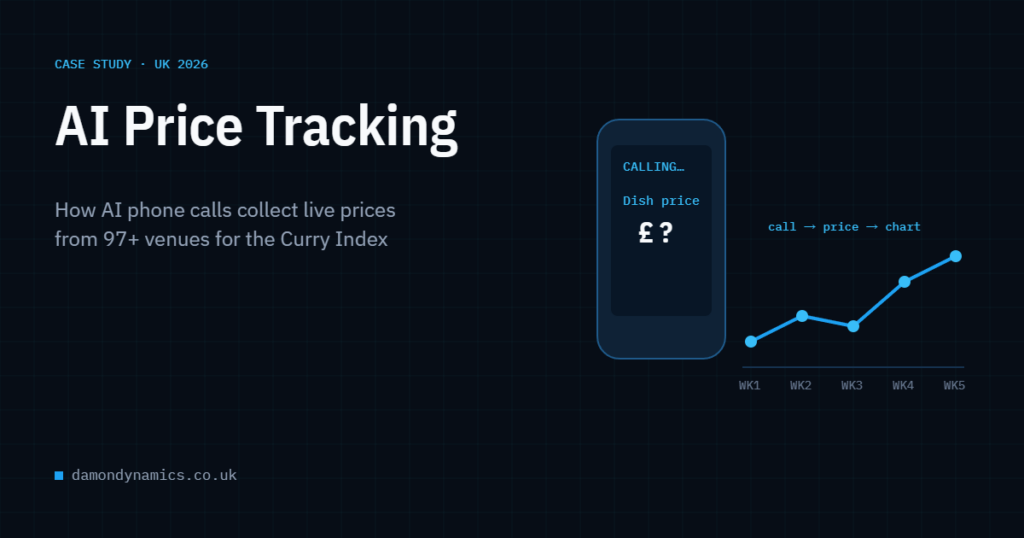
Knowing what your competitors charge today, not last month, is one of the most useful things a business can know. AI price tracking you can rely on is now realistic for small firms. The hard part has never been the maths. It has been getting the prices in the first place.
Many prices are not on a website. They live on menus, in shop windows, or in the head of the person who answers the phone. That is where AI calling comes in. It lets software ask the question a human would ask, then record the answer in a tidy form.
This article uses the Curry Index, a project built by Damon Dynamics, as a worked example. It monitors prices across 97+ venues. We will look at five ways AI calling helps, what it costs, where it goes wrong, and how to start without wasting money.
Table of Contents
What AI price tracking really means for UK businesses
Price tracking is simple to describe. You collect prices from a set of places, on a schedule, and store them so you can see what changed. The “AI” part is about how the collecting and tidying happens.
Traditional price monitoring tools scrape websites. That works well for online shops with a clear product page. It works badly when the price is not published, is hidden behind a form, or changes by branch or by day.
AI price tracking in the UK today usually mixes several methods:
- Web reading, where software pulls prices from public pages.
- Document reading, where AI extracts prices from PDFs, menus and price lists.
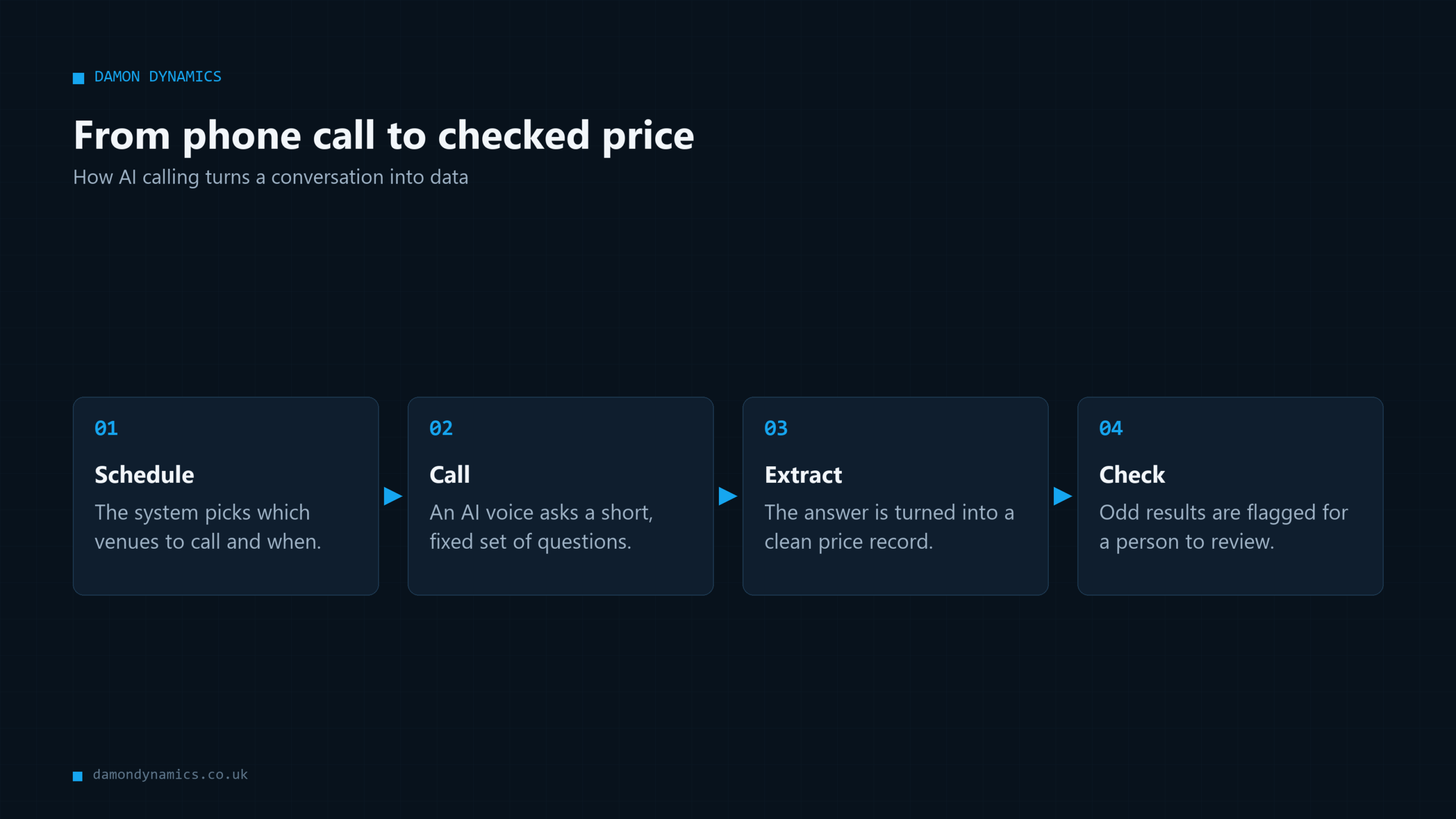
- Voice calling, where an AI voice phones a venue and asks for the price.
- Cleaning and checking, where AI turns messy answers into consistent records and flags oddities.
The first two are well served by existing tools. The third is less common, and it is the one this case study is about.
Why the phrase gets over-sold
Plenty of AI price tracking products claim to offer “AI pricing”. Some only wrap a chart around a scraper. Others make price recommendations that nobody has tested. Be clear about which job you need done: collecting data, understanding it, or acting on it. Each is a separate piece of work with a separate cost.
The Curry Index: a real case of AI price tracking you can see
The Curry Index tracks live prices across 97+ venues. The idea is simple. Instead of relying on out-of-date menus or one-off surveys, it keeps a running picture of what a meal actually costs in different places.
Why use calls? Because many independent restaurants and takeaways do not keep a tidy, current price list online. A menu photo from two years ago is not a price. For AI price tracking, a phone call gets the answer as it stands today.
Doing that by hand is where most projects die. Ringing 97 venues once is a long afternoon. Doing it every week is a part-time job nobody wants. That repetitive, rules-based work is exactly what automation suits.
What the project shows
The Curry Index is not magic. It shows a pattern that applies well beyond food. AI price tracking projects work best when you pick a question with a clear, factual answer. Ask it the same way each time. Record the answer in a fixed format. Compare it with the last answer. Have a person look at anything unusual.
If your business tracks prices for hire rates, trade supplies, local services or competitor quotes, the same pattern can apply. For wider ideas on where automation pays off first, see our guide to AI automation for small business.
5 ways AI calling improves AI price tracking
Here are the five practical benefits, using the Curry Index as the example throughout.
1. It reaches prices that are not online
Web scrapers only see what is published. A large share of local pricing is never published in a usable form. A phone call reaches the venues that sit outside the reach of a normal monitoring tool.
This is the biggest single reason to consider calling. If every price you need is already on a clean web page, use a scraper and save the money. If it is not, calling may be the only automated route for AI price tracking.
2. It covers many venues on a schedule
A person can ring ten places before they get bored. Software can work through 97+ venues on a timetable without losing focus. That makes weekly or even more frequent checks realistic.
Frequency matters because prices drift. A single survey tells you where things stood once. A regular series tells you which way things are moving, and how fast. That trend is usually worth more than any one number.
3. It turns messy answers into structured data
People do not answer in neat fields. One person says “eleven pounds fifty”, another says “about twelve quid”, a third says “it depends on the size”. AI is good at reading this kind of language and mapping it to a consistent record.
The result is a table you can sort, chart and compare. Without that step, you just have a pile of call notes. With it, you have data you can put on a dashboard. If that is your aim, our services page explains how dashboards fit into a build.
4. It flags changes and odd results
Once prices are structured, a system can compare each new answer with the last one. A jump, a drop or a missing answer can be flagged straight away. You then spend your time on the five results that look wrong, not on all 97.
Flagging is also how you catch the system’s own mistakes. A call that mishears “£8” as “£18” will stand out against history. This is why AI assistants for small business work best when they report exceptions, rather than pretending to be right every time.
5. It keeps a record you can check
Every call can be logged with the date, the venue and the answer. If someone asks “where did that price come from?”, you can show them. In AI price tracking, that audit trail is what separates a trustworthy index from a number someone made up.
It also supports a human sign-off. A person can review a sample of results, or all of the flagged ones, before anything is published or used to set your own prices. Nothing customer-facing should go out unchecked.
What the numbers say about AI and pricing in the UK
It helps to see the wider picture before spending money on AI price tracking. Some figures suggest strong interest. Others are a warning.
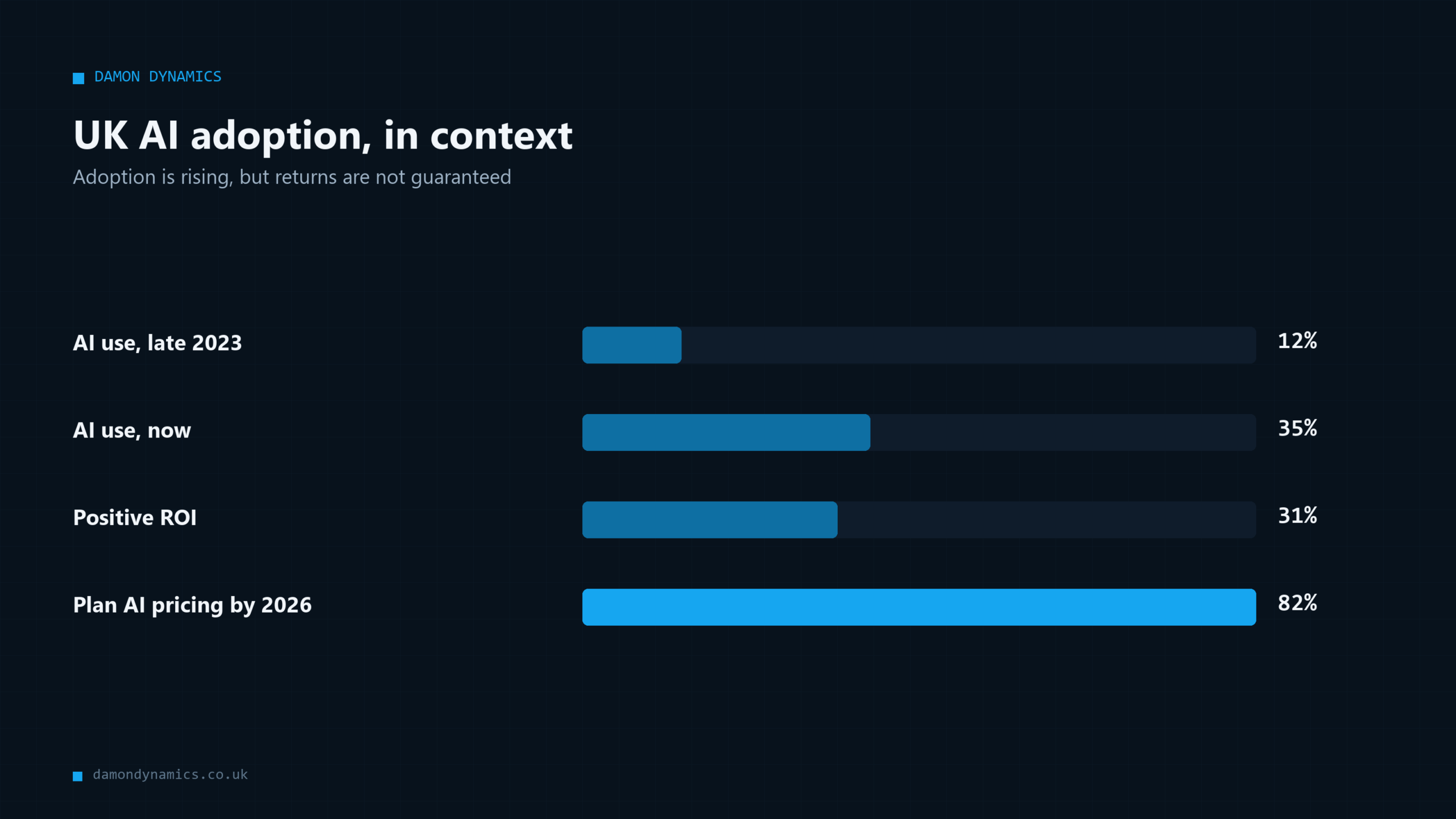
The Office for National Statistics reports that self-reported AI use among UK businesses with 10 or more employees rose from around 12% to around 35% since late 2023. Larger firms are more likely to have adopted it. So smaller firms are not behind, but the gap is real.
On pricing specifically, Miruka cites an Econsultancy report from 2024 saying that 82% of UK e-commerce businesses plan to adopt AI-powered pricing tools by 2026. That is a stated plan, not proof of results, so treat it as a sign of direction.
The reality check
Helium42’s 2026 benchmark report says only 31% of UK organisations report positive return on investment from AI, even though 85 to 91% are increasing their investment. In plain terms, many firms are spending without seeing the payoff.
The lesson is not to avoid AI price tracking. It is to start with a narrow job, measure the result, and only then expand. A project with a clear question and a clear owner is far more likely to pay back than a broad “let’s use AI” plan.
What AI price tracking costs in the UK
Costs vary a lot, and I will not quote other companies’ prices. What I can do is show what drives the bill and give clearly labelled examples.
DSIT fieldwork reported by Heybrb.ai found that UK businesses spent a mean of £19,000 on AI-related activity in 2024, but the median was £2,000. The gap shows that a few big spenders pull the average up. Most firms spend far less.
For your own planning, think about these cost drivers:
| Cost driver | What it affects | Example of a simple vs complex case |
|---|---|---|
| Number of sources | Build and running time | 10 venues vs 100+ venues |
| Source type | Method needed | Public web page vs phone call |
| Frequency | Ongoing running cost | Monthly vs weekly |
| Data cleaning | Build effort | Fixed menu vs free-text answers |
| Review process | Staff time | Spot checks vs checking every result |
| Output | Build effort | Spreadsheet vs live dashboard |
Calling costs more to build than scraping, because speech, timing and awkward answers all need handling. It is usually cheaper than paying a person to ring round every week, but only if you need the data often enough.
Time savings are real but modest
Miruka reports that businesses using automated price alerts save an average of 5 hours per week on manual monitoring, based on its own 2025 data. Treat that as a rough guide from a vendor, not a promise. For example, if your time is worth £20 an hour, five hours a week is £100 a week. Work out your own numbers before you commit to AI price tracking.
For a broader view of how projects are priced, read our guide to AI chatbot cost in the UK. The hidden fees it covers apply to monitoring projects too.
When AI is not the answer
Honesty matters here, because a monitoring project is easy to over-build. Here are cases where I would tell you to do something simpler instead of AI price tracking.
- The price is already public. If a clean web page lists it, use a basic scraper or even a spreadsheet.
- You only need it once. A one-off survey is cheaper by hand.
- You have five competitors. Checking five prices weekly takes minutes.
- You would not act on the result. Data nobody uses is just a cost.
- The venue will not want automated calls. Some people dislike talking to a machine, so consider how it is introduced.
Care points with calling
In AI price tracking, calling people is different from reading a web page. Calls should be short, polite and honest about what they are. Keep the questions narrow, and only ask for business information such as a price. Do not collect personal data you do not need. Check the rules that apply to your use, and our privacy policy shows how we handle data on our own site.
AI also gets things wrong. It can mishear, misread or take a vague answer too literally. That is why the flagging and human review steps described above are not optional extras. They are part of the product.
How to start AI price tracking in four steps
You do not need a large budget to begin. You need a clear question and a small first version.
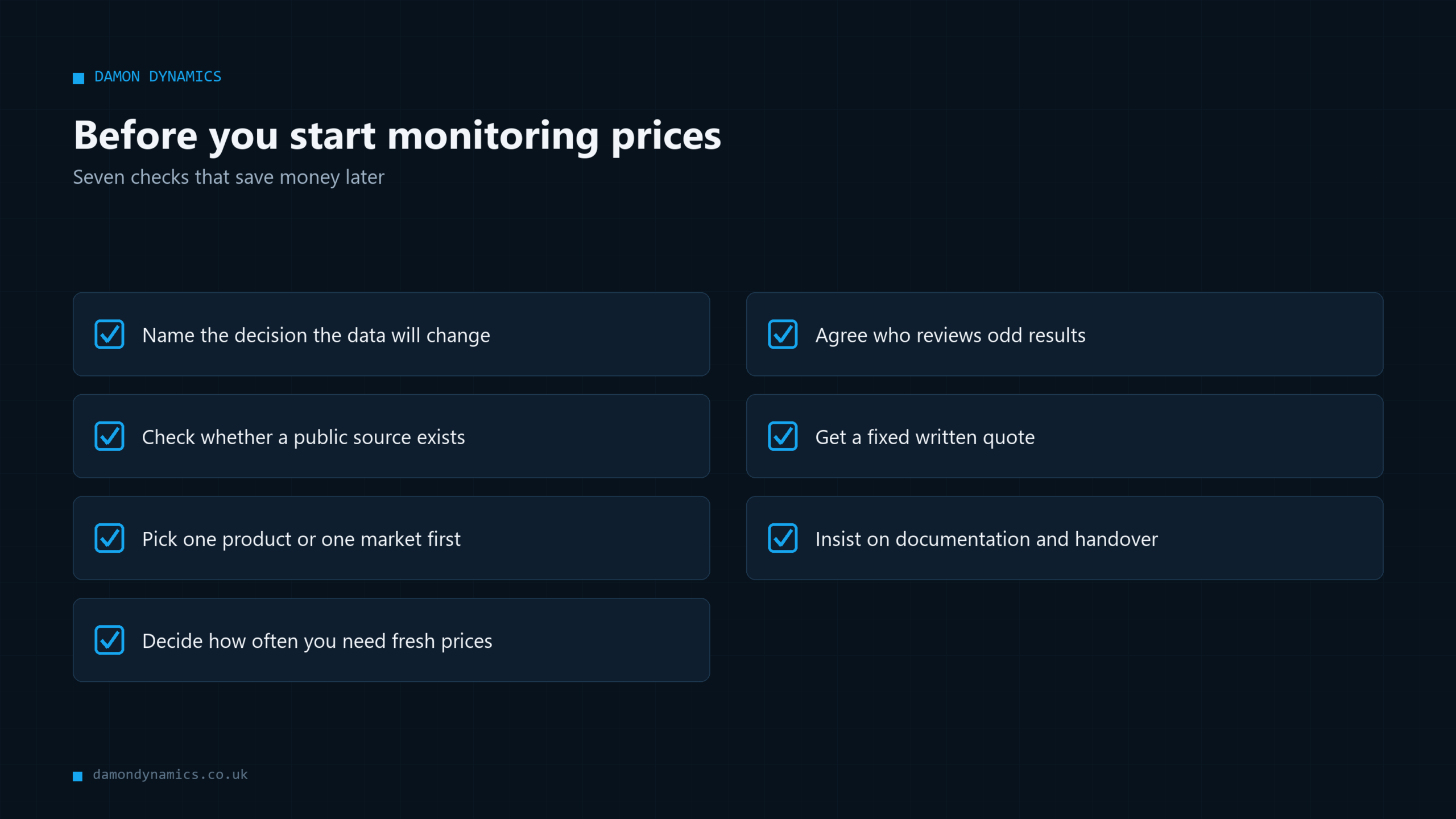
- Name the decision. For example, “Should we change our hire rates this quarter?” The data exists to answer that, not to look impressive.
- List your sources. Write down where each price lives: website, PDF, phone or in person. This tells you which method you need.
- Start with a small set. Ten sources done well beat a hundred done badly. Prove the method, then grow.
- Decide who checks. Name the person who reviews flagged results and signs off anything used in a decision.
Keep the first version boring
A good first version of AI price tracking might be a spreadsheet that updates weekly, with a short list of flagged changes. It does not need a fancy dashboard on day one. Once the numbers are trusted, a dashboard becomes worth building.
Measure it
Set one measure before you start. It could be hours saved, a price change you made because of the data, or a quote you won. If you cannot name a measure, wait. Given that only 31% of UK organisations report positive return from AI, this step is what keeps you in the group that does.
How Damon Dynamics builds live monitoring
Damon Dynamics is an AI engineering company in Bradford, West Yorkshire. We work with businesses across Yorkshire, including Leeds, Halifax, Huddersfield, Wakefield and Keighley, and remotely anywhere in the UK.
The company is run by Damon, who holds an MSc in Artificial Intelligence and Data Science from the University of Hull. He builds every project himself, so you talk to the engineer, not a sales team.
We build AI assistants grounded in a business’s own documents that cite their sources, AI-powered web apps, automation pipelines and data dashboards. The Curry Index sits in the pipeline and dashboard category. Our live products, Plainly Benefits and WaitWell, show the same care for sourcing and accuracy in other areas.
How we work
- A free 30-minute discovery call to understand the question.
- A fixed written quote, with no day rates.
- One workflow first, as a fixed-price project.
- A human approves anything customer-facing.
- Everything documented and handed over, so there is no lock-in.
You can read more about the person behind the work on our about page. If you have a pricing question that is hard to answer because the data is not online, **book a free 30-minute discovery call and we will tell you honestly whether AI calling is the right tool for AI price tracking.**
Frequently Asked Questions
What is AI price tracking?
AI price tracking is software, often with AI, that collects prices from many sources on a schedule and stores them so you can see changes. The AI part usually handles reading messy information, such as spoken answers or menus, and turning it into clean records.
Is AI price tracking legal in the UK?
It can be, but it depends on how you do it. Collecting public business prices is generally low risk. Calling people, storing personal data or scraping sites against their terms needs care, so take proper advice for your own case.
How accurate is AI calling for prices?
It can be good on simple, narrow questions, but it is not perfect. It can mishear or take a vague answer too literally. That is why results should be compared with history, odd ones flagged, and a person should check them.
How much does a price monitoring project cost?
It depends on the number of sources, the method, the frequency and the output. A simple web-based tracker costs far less than a phone-based system. We give a fixed written quote after a free call, so you know the price before work starts.
Can a small business afford it?
Often yes, if the project is narrow. DSIT fieldwork reported a median UK AI spend of £2,000 in 2024, which shows most firms spend modestly. Start with one question and a small set of sources, then expand once it pays back.
Do I need AI calling or is a scraper enough?
If your prices are on clean public web pages, a scraper is enough and cheaper. Calling is worth considering when the price is not published, changes by venue, or is only given out over the phone.
How long does it take to build?
A small first version can be much quicker than a full system, because it covers one workflow and a limited set of sources. We agree the scope in writing first, so you know what is included and when to expect it.