Nobody tells you what to do with the waiting.
Waiting for NHS treatment is the one part of being ill that comes with no timetable and no updates. You see a GP, you get referred, and then the system goes quiet. Weeks turn into months. There is no progress bar, nobody rings to say where you are in the queue, and the pain or the breathlessness or the dizziness carries on regardless. Then a letter lands, you get your appointment, and you have about ten minutes to explain six months of your life to a consultant who has never met you.
Most advice about NHS waiting lists is about how to get seen faster. This is not that. This is about the part nobody covers: what to do with the months in between, so that when your turn finally comes you walk in prepared rather than guessing.
First, know where you actually stand
If you are waiting for NHS treatment in England, you have a legal right to start non-urgent consultant-led treatment within a maximum of 18 weeks of referral. That is set out in the NHS Constitution, and your clock starts when the hospital receives your referral letter, or when you book your first appointment through the NHS e-Referral Service. It is worth knowing the exact date that happened, because it is the date everything else is measured from.
There are exceptions. The right does not apply if delaying treatment is in your clinical best interests, and it does not cover every service. The NHS guide to waiting times in England is the authoritative source and worth ten minutes of your time.
Be realistic about the gap between the standard and reality. The 18-week standard has not been met since 2015, and recent figures put the proportion of patients treated within 18 weeks at around 62%. Knowing your rights is still useful, but plan for a long wait rather than an 18-week one.
Two rights that get overlooked. You can generally choose which provider you are referred to, including one with a shorter list. And if your 18-week wait is going to be breached, you can ask to be offered an alternative provider. Most people have no idea either of these exist.
Write things down, starting today
This is the single highest-value thing you can do, and almost nobody does it.
Here is what happens otherwise. Your appointment arrives in month seven. The consultant asks how bad the pain has been. You think back over 200 days and say “bad, I suppose, worse some days.” That sentence contains almost no clinical information. It is not your fault. Human memory flattens a long stretch of discomfort into a single vague impression, and it is especially bad at remembering how things were before they became normal.
A short daily record turns that into something usable:
- Pain, on a consistent scale. The number matters less than using the same scale every time.
- Mobility. What could you do today that you could not do last month, or the other way round.
- Sleep. How often it interrupted you.
- Mood. Long waits do their own damage, and it is legitimate clinical information.
- The specific thing you could not do. “Could not get up the stairs without stopping” is worth more than any number.
Thirty seconds a day. What it buys you is a trend, and a trend is evidence. “It has got worse” is an opinion. A line going the wrong way over four months is a fact, and it is the kind of fact that changes how urgently someone treats you.
Prepare properly for the ten minutes
Outpatient appointments are short. Go in with a written page, not a memory.
Write down, before you go:
- The three things you most need answered. Not ten. Three.
- How your symptoms have changed since referral, with the dates.
- Everything you are taking, including anything over the counter.
- What you actually want out of this. Pain relief, a diagnosis, a date for surgery, being able to work again. Say it out loud in the room.
Take someone with you if you can. Two people remember twice as much, and it is hard to take notes when you have just been given difficult news.
Learn to read the letters
NHS correspondence is written by clinicians for clinicians. A letter can tell you your referral has been triaged to a different pathway, or that you have been listed for a procedure, without ever saying so in plain English. If you do not understand a letter, that is a problem with the letter.
Ring the number on it. Ask the secretary what it means in ordinary words. They will tell you, and it is a normal thing to ask.
Know when not to wait
Waiting well does not mean waiting quietly through something that has changed.
If your symptoms get significantly worse, if new symptoms appear, or if something feels acutely wrong, contact your GP. Use NHS 111 when you are not sure. Call 999 for anything you think is an emergency. Being on a waiting list is not a reason to sit tight, and a documented deterioration is exactly the kind of thing that can move you up a list.
We built an app that does all of this
Everything above is a manual process, which is why most people do not keep it up past the second week. So we built WaitWell, and it is free.
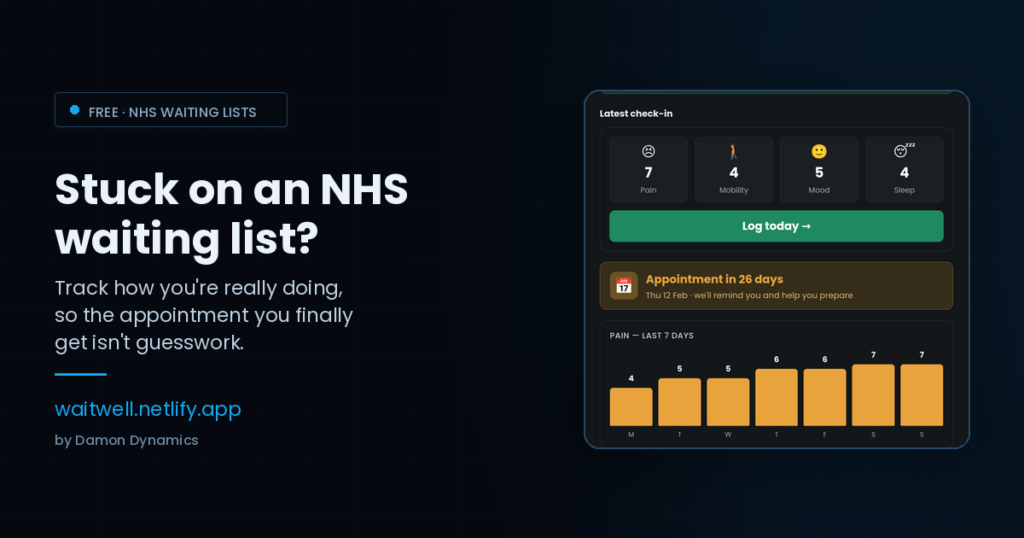
Track in thirty seconds a day. Pain, mobility, mood and sleep, drawn as trends over weeks rather than isolated numbers.
Get an appointment summary written for you. An AI coach reads your own logs and produces a plain-English summary of how things have changed since referral. Print it or show it on your phone.
Photograph a letter, get it explained. Point your camera at hospital correspondence and get the jargon unpacked.
Verified sources. Guidance links go to NHS pages, not forums.
No app store. WaitWell is a progressive web app, so it installs to your home screen straight from the browser and works on a poor connection.
It is open source, and here is why that matters
WaitWell’s entire codebase is public on GitHub: github.com/damonchandio/waitwell.
If an app asks you to log your health every day, you are entitled to know what happens to that data. Rather than ask you to trust a privacy policy, we published everything. The database rules, the prompts, where the AI runs, all of it is readable by anyone.
If you are technical, the stack is a progressive web app on Supabase and PostgreSQL with row-level security, with the language model work running server side in Edge Functions. Issues and pull requests are welcome.
Common questions
How long is the NHS waiting list right now?
NHS England publishes waiting list data monthly, broken down by specialty and by hospital, so you can look up the pressure in your area rather than rely on a national headline.
Can I be seen somewhere with a shorter wait?
In most cases you have a legal right to choose your provider. If your 18-week wait is going to be breached, you can ask to be offered an alternative. Start with the department that holds your referral.
Does missing an appointment restart my wait?
It can. Cancelling or rescheduling may affect your position or reset the referral-to-treatment clock, so contact the hospital as early as you can if you need to change a date.
Is WaitWell free?
Yes. Tracking, the summaries and the letter explainer are all free to use.
Is WaitWell connected to the NHS?
No. It is an independent app built by Damon Dynamics in West Yorkshire. It gives you information and a place to keep your own records. It does not provide medical advice and it is not part of the NHS.
WaitWell is built by Damon Dynamics, an AI and software engineering studio in West Yorkshire. Written by Damon, AI engineer, MSc Artificial Intelligence and Data Science, University of Hull.
This article is general information, not medical advice. For anything about your own condition, speak to your GP, call NHS 111, or call 999 in an emergency.