If you run a small business in the UK, the phone is still how most new customers reach you, and an AI receptionist UK suppliers now sell for less than a part-time wage promises to answer every one of those calls. That promise is worth looking at carefully. An AI receptionist is useful for some businesses and a bad fit for others, and the difference comes down to what you ask before you sign up.
This guide is written for owners, not engineers. It covers what an AI receptionist actually does on a call, what the UK data rules mean for you, what it tends to cost, and seven questions that separate a good supplier from a slick demo. We build these systems at Damon Dynamics, so we have an interest here, and we have tried to be straight about where the technology falls short.
Table of Contents
What an AI receptionist UK businesses can buy actually does
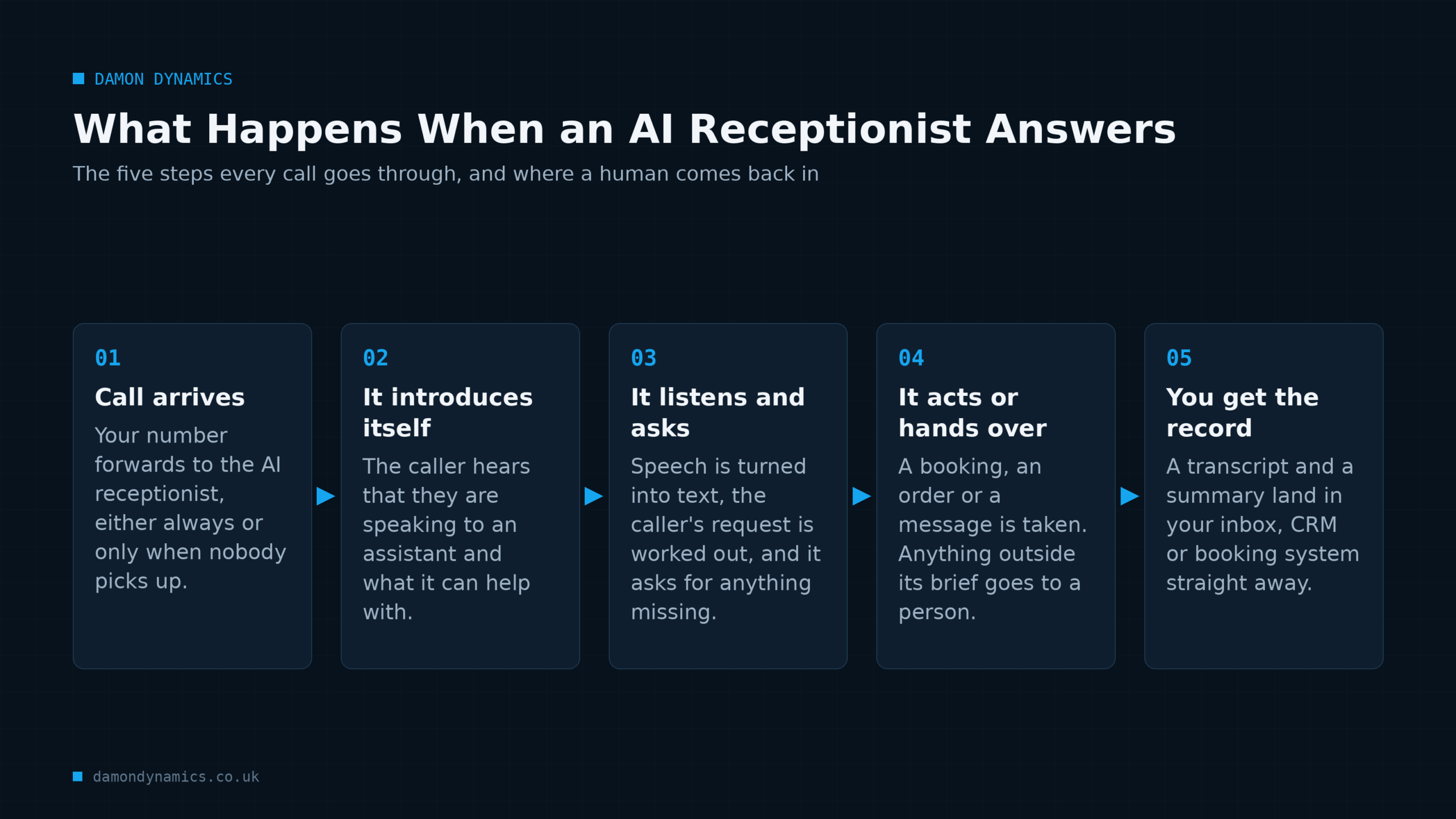
An AI receptionist is software that answers your business phone line, talks to the caller in a natural voice, and does a small number of jobs for you. In practice those jobs are:
- Answering the questions people ring about most, such as opening hours, prices, parking and whether you cover their area.
- Taking a booking or an order and writing it into your calendar or order system.
- Taking a message with the caller’s name, number and reason for calling, then sending it to you by text or email.
- Passing the call to a person when the caller asks for one or when the request is outside what it has been told to handle.
Under the surface it is three pieces of technology joined together. Speech recognition turns the caller’s voice into text. A language model reads that text, works out what the caller wants, and decides what to say or do next. Text-to-speech turns the reply back into a voice. Each piece has got much better in the last two years, which is why an AI phone answering service that would have been laughable in 2022 is now a serious option.
What it is not is a general purpose assistant. A well built AI receptionist for small business use is deliberately narrow. It knows your services, your prices, your hours and your booking rules, and it is told to hand over or take a message for everything else. The suppliers who get this wrong let the model improvise, and improvising is how callers get told you are open on a Sunday when you are not.
Why the phone still matters more than the chatbot
There is a widespread assumption that customers have moved to web chat and WhatsApp. For British consumers that is only half true. YouGov’s 2025 look at British customer service preferences found that 31% of people prefer the phone when contacting a company and 65% use it, second only to email. Chatbots were preferred by 1% and used by 18%.
So the calls are not going away. For a takeaway, a plumber, a dental practice or a car garage, the phone is where the money arrives. That is the real argument for an AI receptionist UK small firms should pay attention to: not that it is clever, but that it picks up.
What missed calls cost a small business
The honest answer is that nobody can tell you exactly what a missed call costs your business, because it depends on what a customer is worth to you and how many of them ring the next number when you don’t answer. The research that exists is older than we would like, but it points one way.
Moneypenny’s small business call report, based on a survey of 300 micro businesses and call data from 10,000 companies, found that a third of small businesses failed to answer incoming calls, and that 69% of callers who reached voicemail hung up without leaving a message. That report is from 2016, and voicemail habits have not improved since, so treat the exact figures as a floor rather than a precise number.
If you want your own number, do this for one week:
- Count the calls that went to voicemail or rang out. Your phone provider’s call log usually shows this.
- Count how many of those left a message.
- Ask each person who did leave a message what they wanted and what it was worth.
Most owners who do this find the gap is bigger than they thought, and that it is concentrated in the same two or three hours of the day. That pattern tells you whether you need an AI receptionist at all, or just a different rota.
Seven honest questions to ask any AI receptionist UK supplier
Every supplier will offer a demo call, and every demo call sounds good, because demos are scripted. These questions are about what happens when the script runs out.
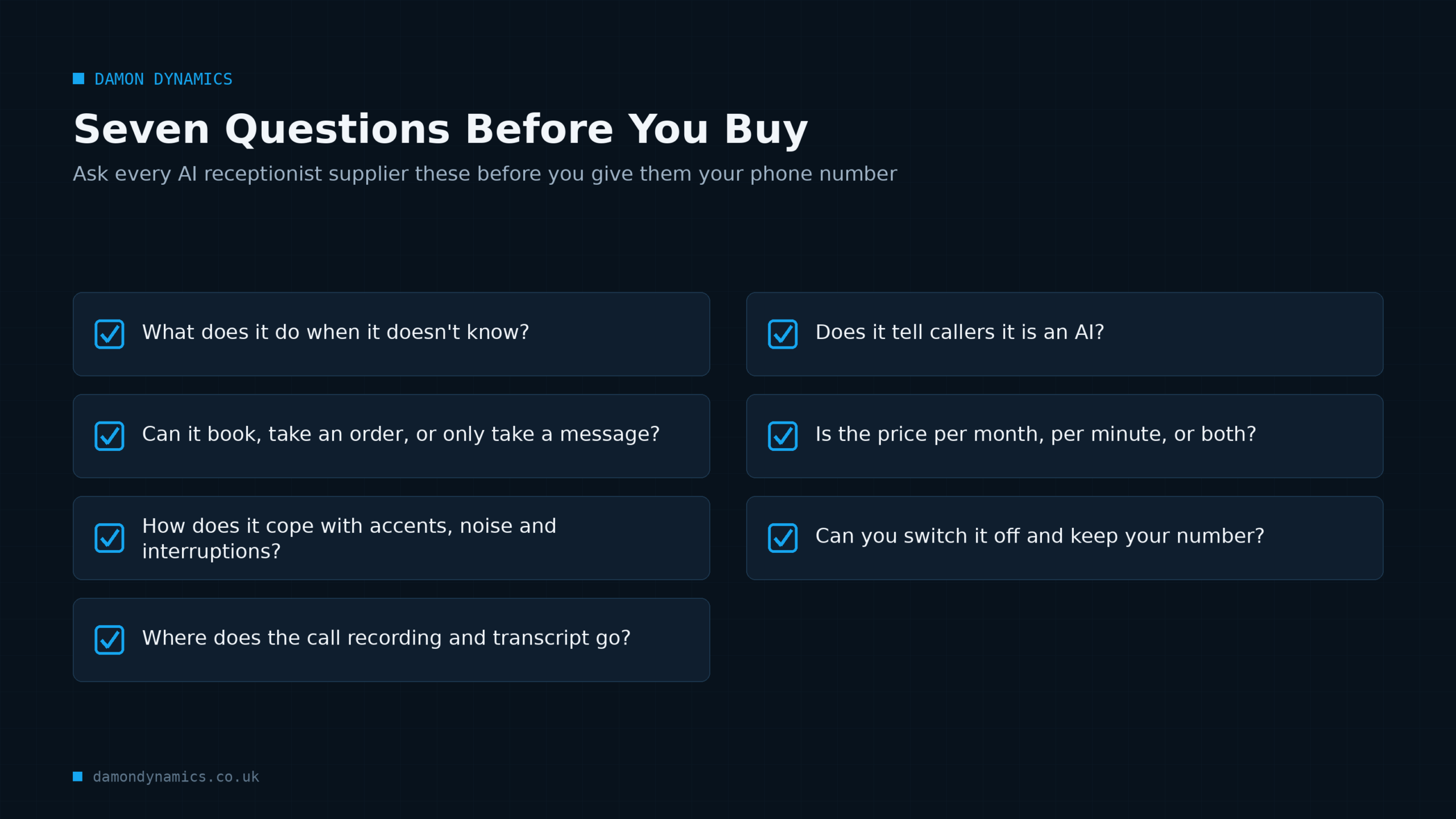
1. What does it do when it doesn’t know?
This is the question that matters most. Ask the supplier to show you a call where the caller asks something the AI receptionist has not been told. The right behaviour is a plain admission (“I can’t answer that, but I can take a message or put you through”), followed by exactly that. The wrong behaviour is a confident guess.
If the supplier can’t show you this, or the system guesses, walk away. A guessed answer about a price or a delivery time costs you more than a missed call does.
2. Can it book, take an order, or only take a message?
Taking a message is the easy part. The value is in the AI receptionist writing a booking into your diary, or an order into your till system, without you touching it. Ask which systems it connects to, and ask to see the booking appear on your side during the demo. “We integrate with everything” usually means “we send you an email”.
For a takeaway, the question is whether it can read your menu, handle “no onions”, and take a collection time. For a trade business, it is whether it can check your availability and offer a slot. For a clinic, it is whether it can see your appointment book without being able to read patient records it has no business reading.
3. How does it cope with accents, background noise and interruptions?
Speech recognition has improved a great deal, but it still has bad days with strong regional accents, a caller on a building site, or someone who talks over the assistant. Test it yourself. Ring the demo number from a noisy place. Interrupt it halfway through a sentence. Give it a Bradford postcode and a Polish surname and see whether it reads them back correctly.
A good AI phone answering service will confirm anything it is unsure about rather than plough on. A bad one records a booking for the wrong name and the wrong street.
4. Where does the call recording and the transcript go?
This is a data protection question and you are responsible for the answer, not the supplier. When the AI receptionist records a call or transcribes it, that recording contains personal data: the caller’s name, number, address and whatever they said. Under UK GDPR you need a lawful basis for processing it, you need to tell callers it is happening, and you need to know where it is stored and for how long.
Ask the supplier:
- Is the audio stored, or only the transcript? For how long?
- Which country are the servers in? If the answer is outside the UK, you need to know the transfer arrangements.
- Is the data used to train the supplier’s models? The right answer for a business line is no.
- Can you delete a caller’s record if they ask?
The Information Commissioner’s Office publishes guidance on AI and data protection that covers transparency, lawful basis and when you need a data protection impact assessment. If you run a medical, legal or financial practice, read it before you buy, because the bar is higher for you.
5. Does it tell callers it is an AI?
It should, in the first sentence. Some suppliers offer a “human-like” mode that avoids saying so. Don’t use it. Callers who find out later feel tricked, and the ICO’s transparency expectations point the same way. The better suppliers have found that a short, clear introduction (“Hi, you’ve reached Ahmed’s Garage. I’m the automated assistant, I can book you in or take a message”) actually gets better results, because callers adjust how they speak.
6. AI receptionist UK pricing: per month, per minute, or both?
AI receptionist pricing in the UK comes in three shapes. Some suppliers charge a flat monthly fee for a number of calls. Some charge per minute of talk time on top of a smaller base. Some charge per call, like a traditional answering service. None of these is wrong, but they suit different businesses.
If your calls are short and frequent, like a takeaway on a Friday night, per-minute pricing can work out cheaply. If your calls are long and detailed, like a solicitor’s intake call, it can run away from you. Ask for the price of a typical month for a business like yours, in writing, including the setup fee, any charge for changes to the script, and what happens if you go over the included calls.
For comparison, our own guide to what an AI chatbot costs in the UK walks through the same build-versus-subscribe decision for web chat, and the logic is the same for the phone.
7. Can you switch it off, and do you keep your number?
You should be able to turn the AI receptionist off in a minute, from your phone, and have calls go straight back to you. You should also own your phone number. Some suppliers give you a new number and ask you to put it on your website and your van. If you leave, the number leaves with them. Keep your existing number and forward it instead, so that nothing you have printed ever needs to change.
AI receptionist vs a human answering service vs voicemail
An AI receptionist for small business owners is not the only option, and for some it is not the best one.
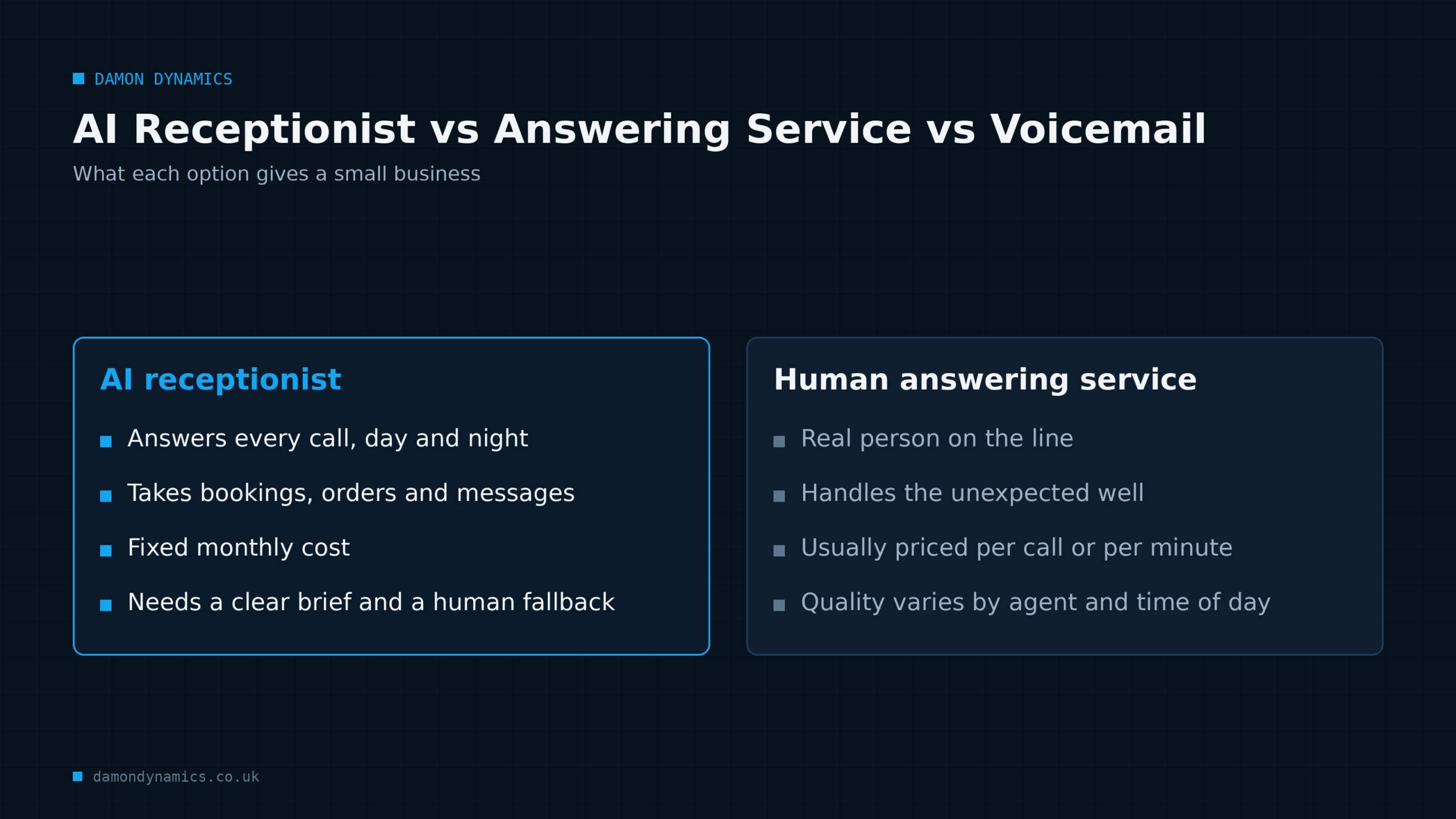
| AI receptionist | Human answering service | Voicemail | |
|---|---|---|---|
| Answers out of hours | Yes, every call | Depends on the plan | No |
| Takes bookings and orders | Yes, if connected to your systems | Usually messages only | No |
| Handles the unexpected | Hands over or takes a message | Well, most of the time | No |
| Typical pricing | Fixed monthly, sometimes per minute | Per call or per minute | Free |
| Set-up effort | A few hours to brief it properly | A call script | None |
| Biggest risk | A confident wrong answer | Inconsistent agents | Callers hang up |
A human answering service still wins when calls are emotional, complicated or high value: a bereavement, a complaint, a six-figure commercial job. An AI receptionist wins when calls are frequent, similar and time sensitive: orders, bookings, “are you open”, “do you cover Shipley”. Voicemail wins only on price, and the research above suggests most callers will not use it.
Plenty of businesses end up with a mix: the AI receptionist handles the routine calls and the out-of-hours ones, and anything it can’t deal with goes to a person during the day.
Who an AI receptionist suits, and who should wait
From the businesses we talk to around West Yorkshire, an AI receptionist for small business use pays off fastest when three things are true.
- You miss calls at predictable times. The lunchtime rush, the school run, when you are up a ladder. If calls go unanswered at the same hour every day, the AI receptionist has a clear job.
- Most calls are about the same few things. Bookings, orders, hours, prices, coverage area. If you can write the top ten questions on one sheet of paper, the system can be briefed well.
- A missed call is a lost sale, not a delayed one. Takeaways, taxis, emergency trades, salons. If the customer rings the next number on the list, every missed call has a price.
It is a weaker fit if your calls are long and varied, if you handle sensitive personal information on the phone, or if your customers are mostly older and ring specifically because they want a person. It is also not a fix for a business that misses calls because it has too few staff for everything else as well. The AI will pick up, but someone still has to do the job the caller booked.
How we build an AI receptionist at Damon Dynamics
We are a small AI engineering company in Bradford. We build AI assistants, automation and web apps for businesses across Yorkshire and remotely across the UK, and the AI phone answering work follows the same rules as everything else we do.
- A free 30-minute discovery call. We listen to how your phone actually rings: when, how often, about what. If an AI receptionist is the wrong answer we will say so.
- A fixed written quote. No day rates and no open-ended bills. You know the cost before anything is built.
- One workflow first. We start with the single most valuable call type, usually bookings or orders, and get that right before adding anything else.
- A human approves anything customer-facing. The script, the voice and the fallback rules are signed off by you, and the system is told to hand over rather than guess.
- Documented and handed over. You get the configuration, the data map and the off switch. No lock-in.
You can read more about our services, or get in touch if you want to talk through whether this makes sense for your business. Clients talk to the engineer who builds it, because there is only one of us.
Frequently asked questions
Is an AI receptionist legal in the UK?
Yes. There is no law against software answering a business phone line. What the law does require is that you handle the personal data on those calls properly under UK GDPR: tell callers the call is being handled by an automated system and may be recorded, have a lawful basis for processing, store the data securely, and delete it when you no longer need it. The ICO’s AI guidance linked above is the place to start.
Will callers know they are talking to an AI?
They should, because the AI receptionist should say so at the start of the call. Most callers are fine with that if the assistant is quick and useful. Problems come when businesses try to hide it.
Can an AI receptionist take payments?
Some can, but taking card details over the phone brings PCI DSS rules into play, and for most small businesses it is simpler to send the caller a payment link by text and let them pay on their phone. We would not recommend reading card numbers to any automated system unless the supplier can show you their PCI compliance in writing.
How long does it take to set up?
For a straightforward business, a few days from the first conversation to live calls, most of which is you writing down the answers to your common questions and deciding what the fallback should be. Connecting a booking or order system adds time depending on the system.
What happens if the internet goes down?
The AI receptionist runs in the cloud, not on your premises, so your office internet does not matter. If the supplier’s own service goes down, your calls should fall back to your normal line or voicemail. Ask the supplier what the fallback is and test it.
Is an AI receptionist better than voicemail?
For almost any business that takes bookings or orders, yes. The research on voicemail is consistent: most callers do not leave a message. An AI receptionist that answers, takes the booking and texts you a summary is doing a job voicemail never did.
Do I need an AI receptionist if I already have a website chatbot?
They do different jobs. A website chatbot helps people who are already on your site. An AI receptionist catches people who picked up the phone instead, which, as the YouGov figures above show, is still a large share of British customers. Many businesses run both from the same brief, so the answers stay consistent.