Introduction
An AI policy for charities is now a core governance document for UK non‑profits. Staff use automated tools to draft reports, write funding bids and summarise meetings. Unchecked use creates risks to data protection, beneficiary privacy and regulatory compliance.
Trustees are ultimately responsible for protecting assets, public trust and personal records. If a donor history is pasted into an unvetted public chatbot, the charity could breach UK GDPR. A clear internal framework removes confusion, prevents accidental leaks and shows staff how to work responsibly.
A practical AI policy for charities establishes straightforward boundaries. For example, it should clarify whether cloud-hosted note-takers are permitted in confidential safeguarding meetings. It must also explain how public large language models store inputs, as many free tools retain user prompts to train future iterations.
To introduce these standards, trustees should first map existing team habits. You cannot govern what you do not track. Audit which platforms are already in use, define an approved tools register, and establish a process for testing new software.
When commissioning external tools, ask vendors direct questions about compliance. Find out where their servers operate, whether your data remains isolated, and if user inputs are excluded from model training. Knowing these technical specifics prevents accidental data breaches before deployment.
Writing your own guidelines does not need costly consultants. This guide outlines the exact building blocks required to protect beneficiaries while allowing staff to work efficiently. Creating a sensible AI policy balances daily administrative gains with proper safeguards.
Table of Contents
Why Every UK Non‑Profit Needs an AI policy for charities
Charities hold some of the most sensitive data in the United Kingdom. Beneficiary records often detail health, financial hardship or legal disputes. At the same time, charities must keep costs low and deliver services with limited funding. This makes automated software attractive to overstretched teams.
Without a formal AI policy, employees will still experiment with online tools. They might use free chatbots to draft case studies, polish funding applications or edit board minutes. In many cases, staff do not realise that public tools may store inputs or use them to retrain models.
A dedicated AI policy for charities sets clear operational boundaries. It protects vulnerable clients, defends reputation and ensures compliance with UK GDPR and Charity Commission guidance. Setting these rules early prevents disputes and protects frontline services.
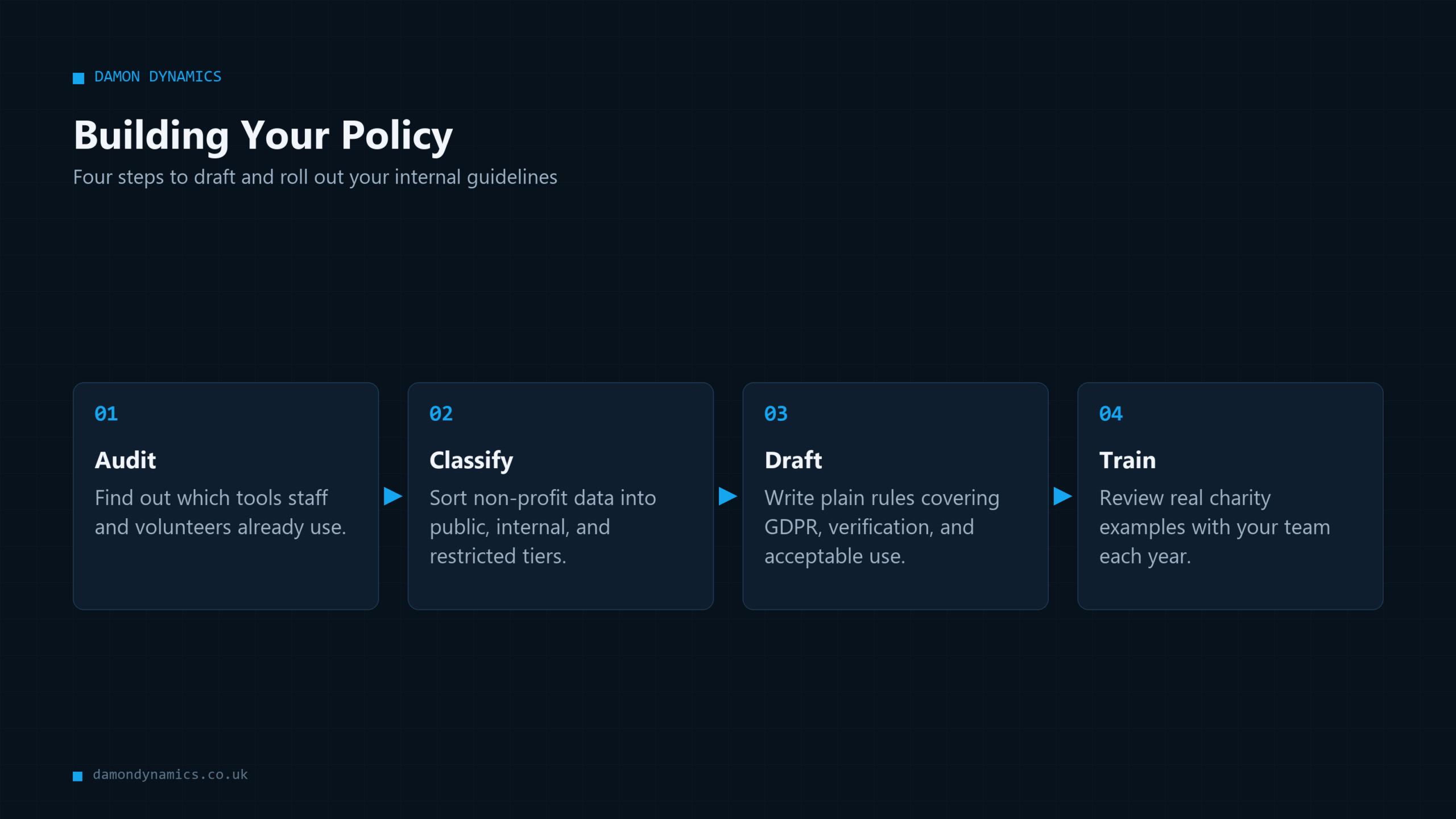
How to create a practical policy
- Audit existing AI use: List every tool, from spreadsheet add‑ons to voice assistants, and note what data is fed into each.
- Classify data sensitivity: Mark records as public, internal, or confidential. Confidential data should never be processed by unapproved external AI services.
- Draft the policy: Include sections on permissible tools, data handling, consent requirements and incident reporting. Use plain language so volunteers can follow it.
- Train staff and volunteers: Run short workshops, provide cheat‑sheets and set up a help‑desk email for questions.
What to watch out for
- Hidden data retention: Some free AI platforms keep logs for up to 30 days. Verify retention periods before use.
- Model bias: Automated decisions about eligibility or support can embed bias; ensure any AI that influences outcomes is regularly reviewed.
- Third‑party contracts: Check that service agreements contain GDPR‑compliant clauses on data processing and deletion.
Questions to ask a supplier
- Where is the data stored and for how long?
- Can you provide a data‑processing addendum that meets UK GDPR standards?
- What audit logs are available to track who accessed the system and when?
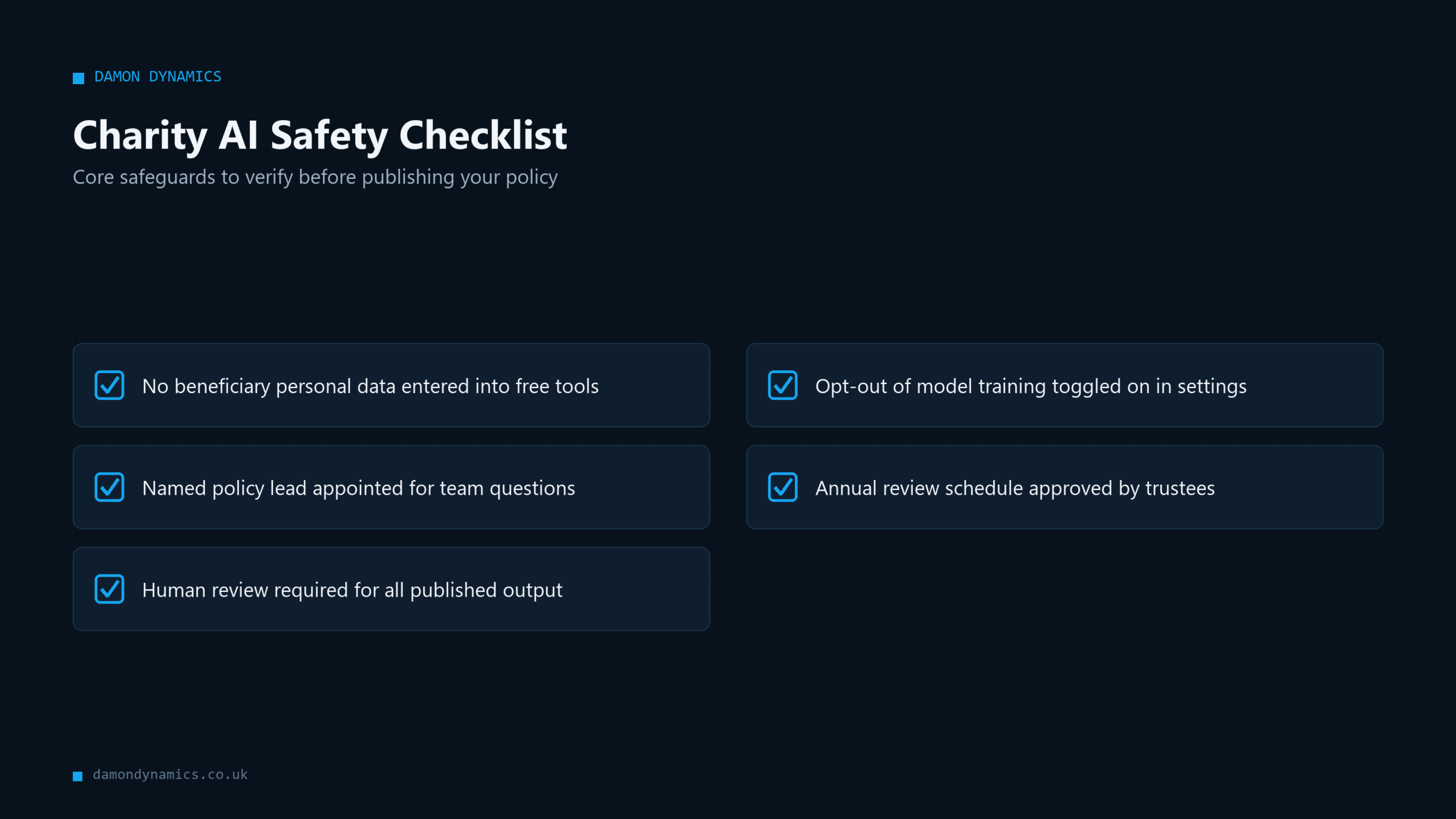
Following these steps will give your organisation a clear AI policy that balances innovation with the duty of care you owe to those you support.
Understanding the Legal Risks: UK GDPR and Data Protection
Under UK data protection law, charities act as data controllers for the personal information they collect. Sharing special-category data with third-party software without explicit legal bases or appropriate safeguards breaches core principles. Special-category records include health, race, religious belief and trade-union membership. If a caseworker enters a beneficiary file into a public chatbot to summarise notes, that action is data processing. Free consumer accounts often reserve the right to process prompt text on servers outside the UK or reuse entries for model training.
A clear AI policy must distinguish public business data from personal beneficiary data. When teams understand data flows, non-profits prevent accidental regulatory breaches. For more detail see our guide on RAG chatbot architecture layers. In secure setups, an internal retrieval system searches documents inside a protected perimeter, avoiding third-party data exposure.
When embedding an AI policy for charities across your team, audit every new software supplier. Ask them directly: Is prompt data retained? Are inputs encrypted in transit and at rest? Is data kept within the UK or covered by standard contractual clauses?
If your team cannot verify where entered data goes, the tool must not handle personal details. A working AI policy provides practical rules for everyday work. Staff may use AI tools to draft grant proposals or format templates, but must never paste beneficiary names, postcodes, or sensitive case records into unverified public systems.
7 Essential Sections of an AI policy for charities
An effective framework must be practical and plain-speaking. Long manuals gather dust. A clear AI policy balances daily administrative efficiency with strict data protection, setting clear operational boundaries.
1. Purpose and Organisational Scope
State why the document exists and who must follow it. Apply it across your entire workforce, including trustees, permanent employees, contractors, and sessional volunteers.
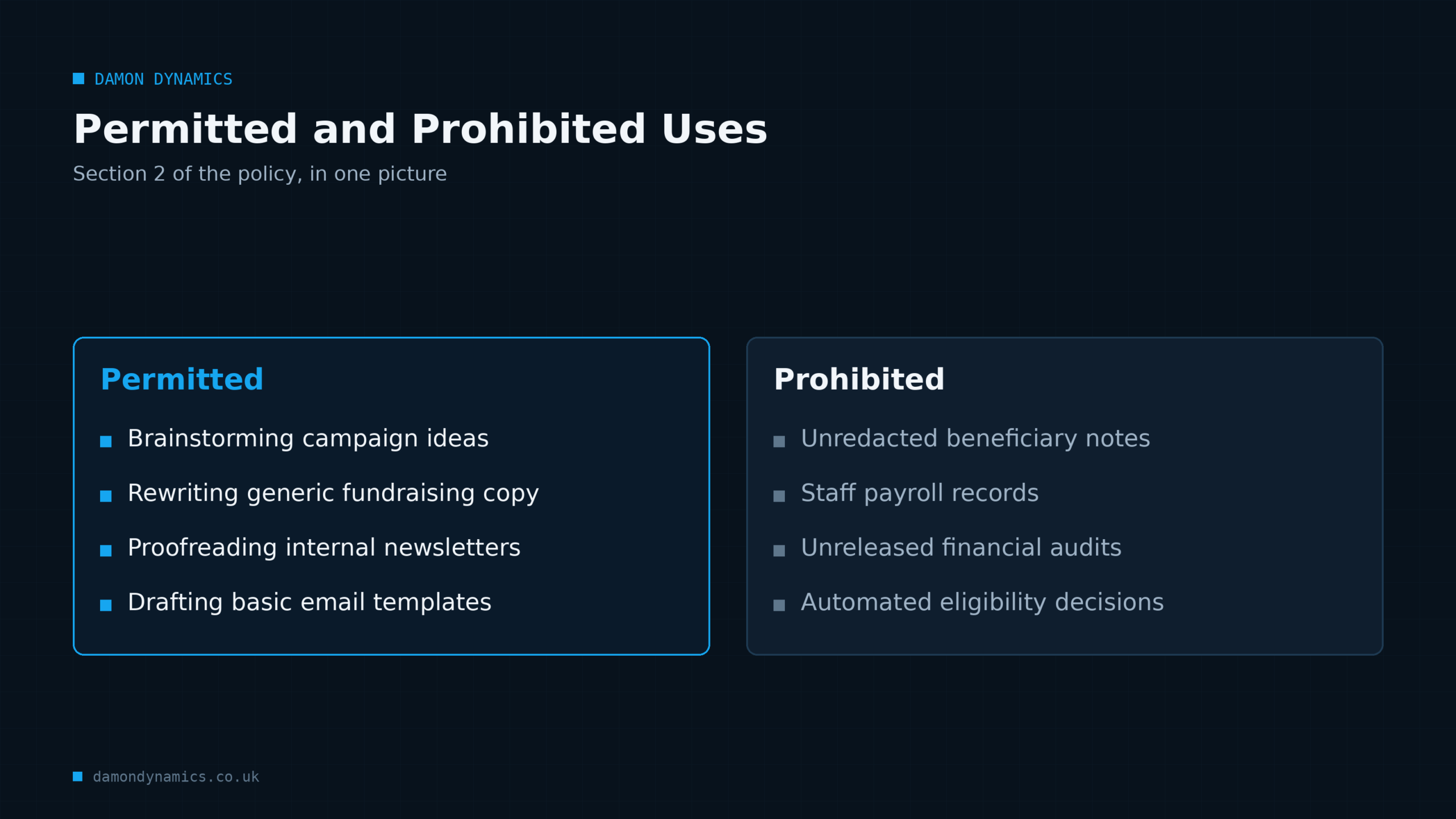
2. Permitted and Prohibited Use Cases
List specific day-to-day scenarios.
- Permitted: Brainstorming campaign ideas, rewriting generic fundraising copy, proofreading internal newsletters, drafting basic email templates.
- Prohibited: Uploading unredacted beneficiary notes, entering staff payroll records, uploading unreleased financial audits, making automated eligibility decisions.
3. Data Classification and Privacy Rules
Every workable AI policy for charities requires a clear data tier system:
| Data Tier | Information Type | Permitted Software | Action Required |
|---|---|---|---|
| Tier 1: Public | Published leaflets, press releases, website copy | Any vetted tool | Normal proofreading |
| Tier 2: Internal | Volunteer rotas, generic project plans, blank templates | Paid accounts with zero data retention | Check commercial terms |
| Tier 3: Restricted | Beneficiary files, safeguarding logs, donor bank details | Strictly banned from external public tools | Keep within secure internal databases |
4. Mandatory Human Review and Accuracy Checks
Generative tools can hallucinate facts. The policy must mandate a human-in-the-loop for every output. Staff must manually verify quotes, figures, and legal references before publication. Our review of the best AI tools for charities highlights platforms with strong verification features.
5. Intellectual Property, Copyright and Transparency
Set explicit disclosure rules. Require staff to declare computer-assisted drafting in grant bids, research papers, and board reports to protect against copyright disputes and preserve donor confidence.
6. Approved Software Register and Procurement
Volunteers must not deploy shadow IT on personal accounts. When implementing an AI policy, maintain a central register of approved platforms. For each one, record who approved it and confirm in writing that prompts are not used for model training. Ask suppliers directly: “Do you train foundational models on prompt inputs?”
7. Governance, Incident Reporting and Review
Implement a blameless reporting protocol for accidental data leaks. If someone pastes sensitive details into an unvetted model, notify the data protection officer immediately so you can evaluate the breach and report to the ICO within 72 hours if necessary. Audit the policy annually.
Safeguarding Beneficiaries and Vulnerable Groups
A comprehensive AI policy must prohibit automated decisions about service eligibility. Human professionals must retain final judgement to avoid bias and ensure dignity.
When selecting software, start by mapping the specific tasks you want to support, for example, data entry, appointment reminders or initial information gathering. Next, check whether the tool offers a “human‑in‑the‑loop” option, where an employee reviews any recommendation before it is acted on. This step is essential for vulnerable clients, as it prevents a system from making a final call on matters such as housing support or safeguarding referrals.
Ask potential suppliers these questions:
- How does the system flag decisions that require human review?
- Can you audit the algorithm’s outputs and trace the data sources used?
- What safeguards are built in to stop the model from learning from biased data?
A practical example is a chatbot that collects basic intake information from a client. The bot can summarise the answers and route the case to a caseworker, but the worker must sign off on any eligibility determination. This approach speeds up paperwork while preserving the personal touch that vulnerable people need.
Be wary of “black‑box” solutions that do not provide transparency on how decisions are reached. Without clear documentation, you cannot demonstrate compliance with your AI policy for charities or with data protection regulations.
Finally, embed regular reviews into your workflow. Schedule quarterly checks where staff test the system with real‑world scenarios and record any discrepancies. Updating the AI policy after each review ensures the guidance stays relevant as technology evolves.
For more on balancing automation with human care, see our breakdown of AI automation for small business.
Paid Software vs Free Public Tools: The Data Difference
Free tiers often treat submitted text as training data. Commercial subscriptions usually guarantee zero data retention for training and provide dashboards to control access.
| Software Model | Average Cost | Data Privacy Standard | Suitability for Non‑Profits |
|---|---|---|---|
| Free Consumer | £0 | Inputs may train public systems | Low: only non‑sensitive ideas |
| Individual Pro | £15‑£20 monthly | Variable; opt‑out required | Moderate: non‑sensitive work |
| Enterprise/Custom | Custom | Zero model training, UK/EU storage | High: required for internal operations |
When drafting an AI policy, start by mapping the type of data you will process. Sensitive donor details, financial forecasts or personal health information should only ever be handled by tools that promise zero model training and store data within the UK or EU. A typical workflow looks like this:
- Identify the use‑case: E.g., drafting a public press release versus analysing donor trends.
- Select the tool tier: Free consumer tools may be acceptable for the press release, but the analysis step needs an Individual Pro or Enterprise licence.
- Configure privacy settings: Enable any available opt‑out flags, set up access dashboards, and confirm that data is not retained for model improvement.
- Document the decision: Record which tool was used, the data type, and the justification in your compliance log.
Questions to ask a supplier include:
- How long is user data stored, and is it ever used to train the model?
- Can you provide a clear audit trail of who accessed the data?
- Is the data residency guaranteed to be within the UK or EU?
Your AI policy for charities should also define a review schedule, for example a quarterly check that the provider’s privacy terms have not changed. Finally, embed a clause that any breach of the agreed data‑privacy standard triggers an immediate switch to a more secure tier. This practical approach keeps the organisation compliant while still benefiting from AI productivity gains.
Remember, the AI policy must be a living document, reflecting both budget constraints and the evolving risk landscape of AI tools.
Step‑by‑Step: How to Roll Out an AI policy for charities
- Conduct an honest software audit: Ask every member of staff and volunteer team which AI tools they already use, from chat‑bots to image generators. Record the name, purpose and any data that is fed into each system. This audit becomes the baseline register for your AI policy.
- Consult frontline staff and volunteers: Hold short workshops or online surveys to discover where AI could save time, for example automating donor thank‑you emails or summarising meeting notes. At the same time, surface any concerns about data privacy or bias.
- Draft the policy in plain English: Use clear headings, bullet points and short sentences. Include sections on acceptable use, data handling, and what to do if an AI output looks suspicious. Keep the language accessible so volunteers without a technical background can follow it.
- Appoint a policy lead: Usually the data‑protection officer or operations manager takes this role. Their duties include maintaining the register, approving new tools and being the first point of contact for any AI‑related queries.
- Run practical training sessions: Demonstrate real scenarios such as redacting donor names from generated reports or checking that a chatbot’s responses do not disclose confidential information. Encourage participants to ask “What could go wrong?” and record the answers.
- Provide safe prompt templates: Offer pre‑approved phrasing for common tasks like social‑media posts, event agendas and meeting summaries. Templates reduce the risk of unintentionally revealing sensitive data and help staff stay within the AI policy for charities.
- Schedule regular reviews: Revisit the register and guidelines every six to twelve months, or whenever a new AI feature is released. Use the review to retire outdated tools and add any new safeguards required.
AI tools change their features and terms often, so keep the review dates in the diary rather than waiting for a problem.
When AI Is Not the Answer for Non‑Profits
An honest AI policy must state when automated tools should not be used. Sensitive frontline communications, legal entitlement decisions and nuanced welfare advice require human expertise. Automated responses can feel dismissive and may provide inaccurate information.
A practical way to enforce this is to map each type of interaction to a decision tree. Start by listing all contact points (phone calls, email queries, web‑form submissions) and assign a risk rating (low, medium, high). For high‑risk items such as benefit eligibility or safeguarding concerns, the tree should route the query to a trained staff member without any AI interjection. For low‑risk FAQs, a simple chatbot can hand out static information, but only after the content has been vetted by a subject‑matter expert.
For statutory advice, dedicated platforms built on verified gov.uk guidance, such as our Plainly Benefits service, are far safer than generic chatbots. These platforms pull directly from official datasets, apply the latest policy rules and log every interaction for audit purposes. When evaluating a supplier, ask:
- How often do you update the knowledge base against gov.uk releases?
- Can you provide an audit trail of the advice given?
- What escalation process is in place for queries the system cannot answer?
Frequent model updates increase the need for clear human oversight. Each new model may change how prompts are interpreted, so a clear AI policy should include a quarterly review of model performance, bias testing and staff training.
Finally, remember that technology is a tool, not a replacement for empathy. Regularly solicit feedback from service users to ensure that any automated element is adding value rather than creating friction. This approach keeps your charity compliant, trustworthy and focused on its core mission.
Tailoring the Policy for Small Community Groups vs National Charities
A small local food bank needs a two‑page policy: no beneficiary names in tools, no financial data, use tools only for marketing copy, and have a trustee review all public material. When setting up an AI policy for charities at this grassroots level, keep the rules immediate and actionable. For example, volunteers drafting social posts or funding appeals can paste general bullet points into an assistant, but they must keep personal backstories off the web.
National charities require detailed frameworks: multi‑tiered data structures, API integrations, formal procurement and audit committee sign‑off. The core objective remains the same: protect sensitive information while enabling efficient work. When an enterprise-level non-profit drafts an AI policy, it must map distinct access levels across regional branches, safeguarding teams, and central fundraising departments.
To make this practical, determine who uses which tools and how the inputs are stored. Check default settings: many commercial consumer tools harvest prompt history to train future models unless you explicitly opt out or purchase enterprise licences. For charities building custom systems, ensure standard operational procedures address internal data handling before connecting knowledge bases.
Before purchasing or commissioning third-party software, ask suppliers clear questions:
- Is charity data kept entirely segregated within the UK or European data regions?
- Are user inputs ever used to train public or foundational models?
- What auditing tools are available to track how staff interact with the system?
Review these rules annually. As teams adopt automation, an AI policy must evolve from a basic list of restrictions into a structured guide that supports safe, day-to-day service delivery.
How Damon Dynamics Helps UK Charities
Damon Dynamics offers clear, secure AI solutions built for charities across Leeds, Halifax, Huddersfield and beyond. Whether you need to streamline donor enquiries, summarise meeting minutes, or draft volunteer rotas, the work starts by aligning technical delivery with a sensible AI policy for charities.
Every engagement follows a straightforward, low-risk structure:
- Free 30‑minute discovery call
- Fixed written quote, no open‑ended day rates
- One‑workflow, fixed‑price pilot project
- Full documentation and handover, no vendor lock‑in
We build secure AI assistants that cite private documents, enforce human‑in‑the‑loop controls and agree up front where your data is stored. In practice, retrieval-augmented generation (RAG) means the assistant only answers questions using your approved internal files, such as internal service handbooks or grant criteria. This design reduces made‑up answers and ensures staff can review every generated output before it reaches beneficiaries or partners.
When working with any external developer, third-sector leadership should verify where sensitive files reside and who retains ownership of the source code. A clear AI policy will establish clear guardrails for beneficiary confidentiality, staff oversight, and data retention limits. Setting up an internal AI policy early on helps trustees, staff, and donors understand exactly how and why automation is used.
We document every system thoroughly so your internal team can manage the tooling independently after launch. Learn more on our dedicated AI services page.
Ready to protect your charity while modernising administrative workflows? Book your free 30‑minute discovery call with Damon Dynamics today.
Want an assistant like this on your own website? Our AI chatbot is built from your own site, answers only from your information and costs £99 a month with no setup fee. You can try a free demo on your website first.
Frequently Asked Questions
What is an AI policy for charities?
An AI policy is an internal governance document that sets rules for using automated software. It defines data‑protection standards, approved tools and boundaries to protect beneficiary privacy.
Why does a small UK charity need an AI policy?
Even small groups handle confidential donor and safeguarding records. Without an AI policy, volunteers may unintentionally upload private data to free chatbots, causing regulatory breaches.
Can charity staff use free tools like ChatGPT for grant applications?
Free tools can be used for brainstorming or style polishing, provided no confidential beneficiary information is included. An AI policy must require manual fact‑checking of all statistics and claims.
How does UK GDPR apply to artificial intelligence in non‑profits?
Entering personal or special‑category data into public AI tools counts as data processing. Charities need a legal basis, must verify vendor compliance and ensure data is never used for external model training.
Who should manage and update the charity AI policy?
Typically the data‑protection officer, operations manager or a designated trustee. This person maintains the approved software register, answers queries and ensures an annual board review.
What should happen if an employee breaches the AI policy?
The policy should provide a blame‑free reporting path so staff can immediately report accidental uploads. Early reporting enables risk mitigation and, if required, ICO notification within statutory deadlines.
Can an AI policy help non‑profits secure grant funding?
Yes. Funders increasingly ask how charities handle data. An AI policy demonstrates mature, ethical use of digital tools and can strengthen funding applications.