Choosing the right AI tools for charities can help small non-profit teams save hours of administrative labour every week without risking donor trust. UK charities often operate with lean operational budgets, heavy reporting duties, and strict data protection responsibilities. Finding software that genuinely assists your daily mission without creating legal risk is essential for trustees and team leaders alike.
Many charitable organisations hesitate to adopt automated systems because they fear data breaches or high recurring subscription bills. Commercial platforms advertise quick productivity gains, but non-profits must handle sensitive beneficiary records under strict UK GDPR standards. This engineer’s breakdown explains which AI tools for charities deliver measurable assistance, how non-profit discounts work, and how to maintain total control over your records.
By approaching software selection with an engineer’s focus on privacy, source citation, and clear workflows, your organisation can protect its funds while removing tedious manual bottlenecks. Assessing modern AI tools allows your team to automate routine administration safely. Here is what non-profit leaders must know about testing, budgeting for, and deploying modern artificial intelligence safely.
Table of Contents
Why UK Non-Profits Need a Grounded Approach to AI
Many charity teams lose hours each week answering repetitive questions, drafting routine funding updates, or summarising long trustee board papers. Adopting AI tools for charities is not about replacing dedicated team members or relying on automated decisions for vulnerable service users. It is about removing the friction of manual data sorting so staff can focus on frontline support.
Generic consumer tools often invent facts when they lack data. In the engineering world, this is known as hallucination. For a commercial business, a wrong answer can be annoying. For a registered charity providing advice on statutory benefits, legal housing rights, or medical care, an invented answer can cause severe harm. That is why these tools must rely on verified internal documentation rather than open-ended web guesses.
Charities also face unique regulatory oversight from the Charity Commission and the Information Commissioner’s Office. Trustees must be certain that operational tools do not expose private personal data to public training datasets. Taking a disciplined, measured approach ensures your organisation gains practical efficiency without compromising its founding values.
Key Compliance Rules for UK Non-Profit Data
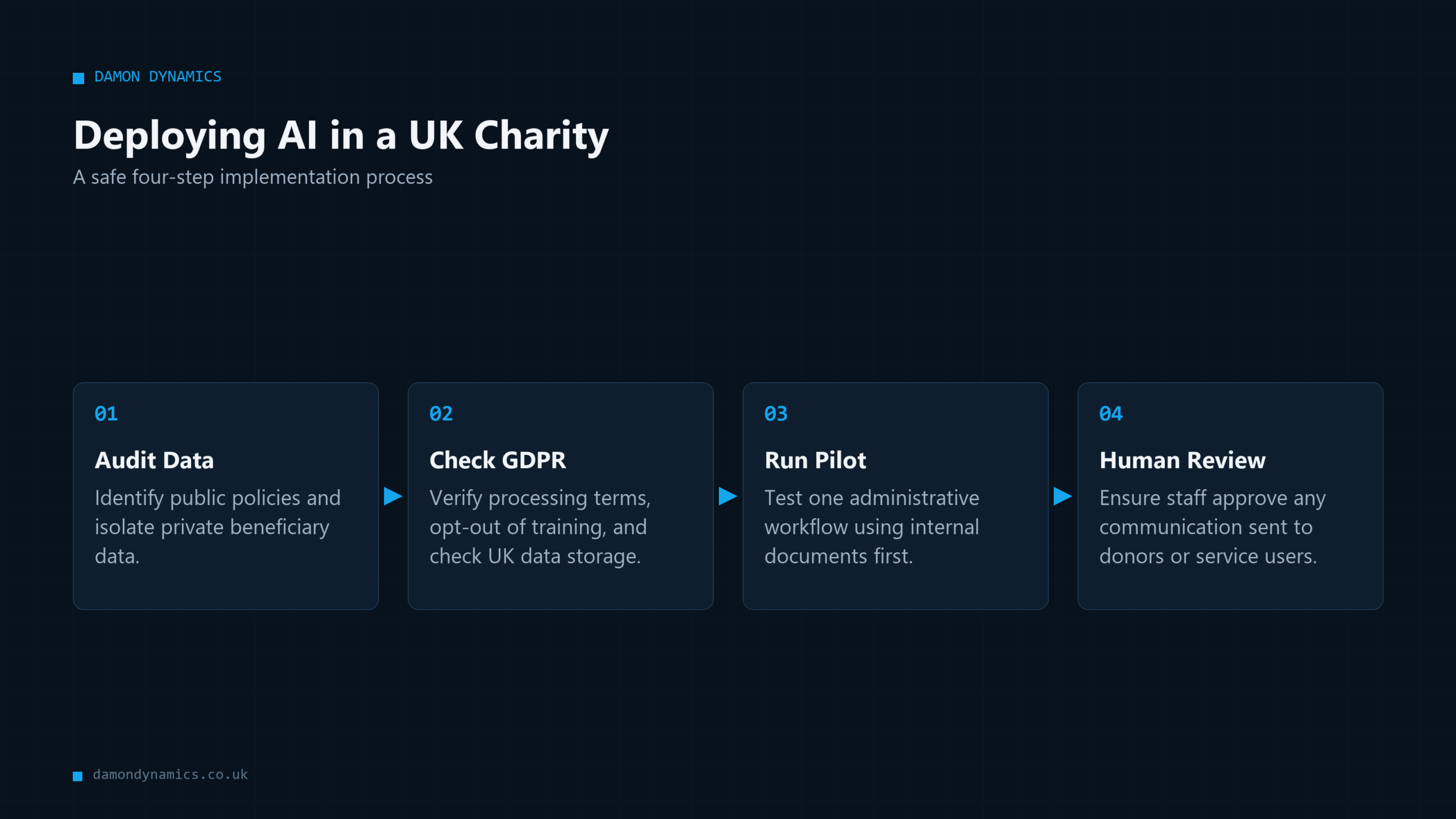
Before you deploy any AI tools for charities, you must review your data protection safeguards under UK GDPR. Every charity handles personal information, including donor payment details, volunteer contacts, and highly sensitive beneficiary case notes. The Information Commissioner’s Office makes it clear that using third-party artificial intelligence platforms does not remove your legal duties as a data controller.
Protecting Special Category Beneficiary Data
Special category data includes medical histories, racial origins, religious beliefs, and trade union memberships. You should never paste this information into free consumer platforms. Free tools often retain prompts to train their general models, meaning your confidential notes could be reproduced in responses given to external users.
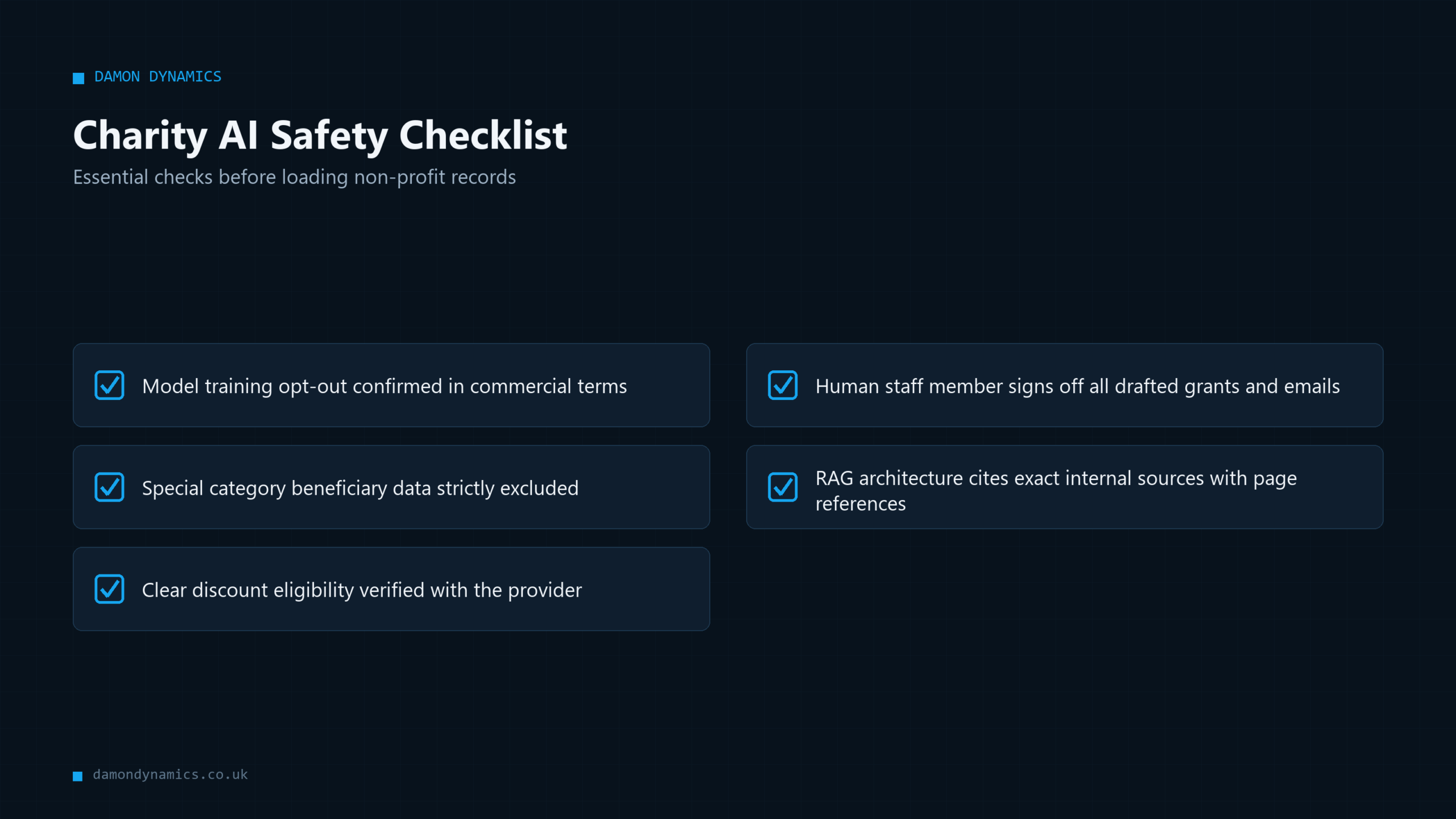
When configuring any tool, verify that the vendor signs a proper Data Processing Agreement. Ensure the terms explicitly confirm that customer data is never used to train future foundation models. If a platform cannot offer that guarantee in writing, do not upload your beneficiary files. Reliable vendors will always provide clear data boundary commitments in their commercial contracts.
Keeping a Human in the Workflow
Automated systems should draft text, search internal documents, and prepare spreadsheets, but human staff must retain final editorial control. Never allow automated tools to send unreviewed case advice directly to a vulnerable person. Requiring a human sign-off ensures errors are caught immediately, maintaining the professional standard your service users rely upon.
7 Practical and Secure AI Tools for Charities
Selecting reliable software requires looking past marketing claims to examine actual features, data privacy commitments, and non-profit pricing tiers. Below are seven practical AI tools for charities that address specific administrative bottlenecks.
1. Claude by Anthropic
Claude is a natural language platform known for strong reasoning, nuanced writing, and large context windows. Non-profit teams can feed lengthy consultation documents, five-year strategic plans, or comprehensive grant applications into a single conversation. It can extract key milestones or draft plain-English summaries for community newsletters without losing nuance.
Anthropic provides commercial workspace plans where submitted data is not used for model training by default. For UK charities that must synthesise thick public policy papers or review grant monitoring forms, Claude ranks among the most capable options. Staff can ask it to compare two operational proposals against the charity’s internal strategy document and flag gaps in seconds.
2. ChatGPT Business and Enterprise
Developed by OpenAI, ChatGPT remains the most widely used conversational AI tool. Free personal accounts can use your chats to improve models unless you turn that off, while ChatGPT Business (formerly Team) and Enterprise do not train on your organisation’s data by default and come with an admin console.
Through OpenAI for Nonprofits, eligible organisations get 20% off ChatGPT Business and 50% off Enterprise, and since February 2026 OpenAI says nonprofits can get up to 75% off by speaking to its sales team. Small teams can use these plans to draft fundraising emails, rewrite policies or build spreadsheet formulas. A person should still review every draft before it goes out.
3. Microsoft 365 Copilot for Non-Profits
For organisations already using Microsoft 365, Copilot works inside Word, Excel, Outlook and Teams. Since November 2024 Microsoft has given eligible nonprofits 15% off Microsoft 365 Copilot, bringing it to $25.50 per user per month on an annual plan, on top of its wider nonprofit pricing for Microsoft 365.
Because Copilot works inside your existing Microsoft tenancy, it respects your organisation’s document permission rules. A volunteer drafting an email cannot accidentally surface confidential trustee salary spreadsheets if their user account lacks folder access. This enterprise security architecture makes it one of the safest AI tools for charities handling sensitive internal operational records.
4. Google Workspace for Nonprofits (Gemini and NotebookLM)
If your charity uses Google Workspace, the free Workspace for Nonprofits edition now includes the Gemini app and NotebookLM at no cost, with Google’s enterprise-grade data protections. Gemini can draft and rewrite text, run Deep Research on a topic and hold spoken conversations, while NotebookLM lets staff upload policies or reports and ask questions that are answered from those sources.
For small charities this is often the cheapest way to start, because there is no per-seat fee. Google lists some features as limited or unavailable on the nonprofit edition, including Gemini inside Gmail and Docs, so check the current feature list before you plan around a specific tool.
5. Otter.ai for Meeting Governance
Charity boards and team meetings require rigorous note-taking, but transcribing hours of discussions drains administrative time. Otter.ai joins virtual calls on Zoom, Google Meet, or Microsoft Teams to capture spoken conversations and produce indexed transcripts. It automatically extracts key action points, owner assignments, and summary outlines.
Otter has offered nonprofit discounts through TechSoup partner programmes in some countries, so check whether one is available to your charity before paying full price. By automating trustee meeting minutes, staff save hours of typing, but someone should still check the record of every governance decision.
6. Canva for Charities
Canva provides its complete premium design suite free of charge to registered charities and non-profits worldwide. The platform includes generative writing and image editing tools that help non-profits produce annual impact reports, social media assets, and fundraising leaflets. Small communications teams can resize graphics instantly or rephrase campaign slogans for different audiences.
Because the core design platform is completely free for verified charities, it offers exceptional value. It allows smaller community trusts to create polished, professional campaign materials without paying expensive agency fees. For accessible visual design, Canva remains an outstanding option for volunteers with minimal design experience.
7. Custom Retrieval-Augmented Generation (RAG) Assistants
Commercial off-the-shelf software cannot always solve the specific problem of searching internal charity policies accurately. An engineered RAG system links a language model directly to your approved PDF manuals, guidance handbooks, and service rules. When an employee asks a question, the system searches only those verified documents and quotes the exact page reference.
Unlike public chatbots, custom RAG options stand out among AI tools for charities because they never rely on unverified web opinions. If the answer is not contained in your uploaded charity handbooks, the system simply states that the information is missing. For charities providing specialised support, building a grounded assistant prevents dangerous hallucinations while keeping your internal files on isolated, secure UK servers.
Comparing the Best AI Tools for Charities
When selecting between commercial platforms and custom software, non-profit directors must balance subscription fees, feature limits, and privacy settings. Reviewing established AI tools for charities side by side makes it easier to allocate limited IT budgets. The table below outlines how these options compare for typical non-profit use cases.
| Platform | Primary Use Case | Typical Non-Profit Pricing | Privacy and GDPR Posture |
|---|---|---|---|
| Claude (Anthropic) | Complex policy analysis and long-form drafting | Standard commercial rates | Workspace plans opt out of model training |
| ChatGPT Business | Everyday writing, communications, and data sorting | 20% off Business, 50% off Enterprise (up to 75% via sales) | Dedicated admin console; zero training on inputs |
| Microsoft Copilot | Document search and email drafting in Microsoft 365 | 15% off Microsoft 365 Copilot ($25.50/user/month) | Built into organizational M365 security boundary |
| Google Workspace for Nonprofits | Drafting, research and Q&A over your own documents (Gemini, NotebookLM) | Free for eligible nonprofits | Enterprise-grade data protections |
| Otter.ai | Board meeting minutes and team action tracking | Check TechSoup partners for discounts | Transcripts encrypted; enterprise controls available |
| Canva for Nonprofits | Social media assets, posters, and impact reports | Free for eligible registered charities | Cloud design workspace; standard privacy terms |
| Custom RAG Assistant | Accurate internal advice citing charity policy sources | Fixed-price bespoke deployment | Complete data isolation on UK or private servers |
What Does an AI Chatbot Cost for a UK Charity?
Charity finance directors must account for every pound spent from restricted or unrestricted reserves. Many non-profit leaders wonder what an AI chatbot costs in the UK before agreeing to an upgrade. Off-the-shelf tools carry low monthly per-seat fees, but those subscriptions can climb rapidly as volunteer numbers grow.
For simple drafting, commercial non-profit licences usually cost between £10 and £25 per user each month. However, standard subscriptions do not connect cleanly to proprietary charity databases or handle bespoke workflows. A bespoke build requires an upfront development investment, but it eliminates per-seat licence fees that penalise your charity as your team expands.
A grounded custom assistant tailored to your exact handbooks typically costs between £2,000 and £5,000 to design, test, and deploy as a one-off project. Understanding your long-term volume helps determine whether commercial tools or a fixed-price custom solution offers better value for your organisation over a three-year funding cycle.
How Charities Can Build Custom Assistants Using Their Own Documents
Off-the-shelf chatbots are trained on wide internet data, which means they can sound confident even when they are incorrect. When a charity handles complex regulatory rules, community members need verified facts, not generic guesses. Building a grounded assistant using a RAG chatbot architecture with secure layers ensures that every answer directly references your charity’s verified handbooks, giving you far more control than generic public systems.
A grounded workflow follows four basic steps:
- Document Ingestion: Your approved operational policies, service guides, and volunteer handbooks are converted into searchable text chunks.
- Semantic Search: When a user asks a question, the search engine scans your specific archive to locate the exact relevant paragraphs.
- Context Injection: The language model receives only those retrieved paragraphs along with the user’s question, instructing it to use nothing else.
- Source Attribution: The system outputs an answer accompanied by page numbers and direct document links so the human adviser can verify the facts instantly.
This process eliminates guesswork. If a community volunteer asks how to refer an applicant for emergency heating grants, a custom assistant will pull the criteria directly from your local authority partnership agreement. It will not guess based on outdated rules from other councils.
We have applied this exact architecture in practical public services. Our live product, Plainly Benefits, answers complex Personal Independence Payment (PIP) and Universal Credit questions using official guidance from gov.uk, complete with direct links to the relevant statutory source materials. We also built WaitWell to help people navigate long NHS waiting lists safely. By grounding AI in verified guidance, these tools empower users without providing unreliable information.
4 Practical Tasks UK Charities Should Automate First
When introducing new systems, starting small prevents staff fatigue and allows you to measure results clearly. Trying to automate everything at once creates operational confusion and risks data compliance errors. For practical ideas on selecting initial targets, see our guide on AI automation for small business.
1. Grant Application First Drafts
Charity fundraisers spend days rewriting the same core organisational history, governance structures, and mission statements for different grant applications. With AI, you can feed in your past successful bids and ask the software to adapt your standard text to fit a new trust’s specific word limits. A human grant writer then refines the output, adding current local statistics and personal case studies.
2. Triage of Inbound Community Enquiries
Many charities receive dozens of general inquiries every morning through website contact forms. Staff often spend hours redirecting people to food banks, council housing offices, or health services. An automated intake assistant can review the inquiry, suggest the relevant internal department, and draft a polite standard referral message for a staff member to approve with one click.
3. Trustee and Committee Meeting Summaries
Board governance requires accurate records, but few charity executives have time to review multi-hour voice recordings. Speech-to-text platforms transcribe meetings instantly, producing concise lists of agreed resolutions, financial votes, and assigned tasks. Using transcription tools creates transparent governance files for annual Charity Commission returns without eating up executive time.
4. Drafting Case Studies from Rough Field Notes
Field officers frequently collect bullet points about community projects, but turning those raw notes into engaging donor stories takes time. Generative AI can transform brief field observations into structured, professional impact summaries. The worker simply checks that all names have been anonymised and confirms the story reflects the real situation accurately before sending it to supporters.
Common Mistakes UK Charities Make with AI
Adopting new software involves learning curves, but mistakes in the non-profit sector can lead to reputational damage or regulatory fines. Being aware of frequent pitfalls helps your board establish clear internal policies from the start.
- Uploading Unredacted Personal Records: Staff members should never paste donor credit cards, volunteer addresses, or client case files into public generative tools. Always establish a clear data sanitisation policy before using any cloud platform.
- Publishing Unverified Grant Claims: Language models can generate plausible-sounding outcomes that your charity never achieved. If a grant application contains fabricated impact metrics generated by unmonitored software, funding bodies will reject the bid and may blacklist the organisation.
- Ignoring Software Lock-in: Subscribing to proprietary systems that hide your data behind expensive export walls can drain charity funds over time. Ensure your data remains portable in open formats like CSV, PDF, and standard JSON when adopting third-party software.
- Failing to Train Volunteers: Buying licences without teaching frontline staff how to write effective prompts leads to poor adoption. Team members will quickly abandon tools that produce generic, unhelpful text.
- Assuming AI Understands Local Context: Commercial tools trained on international data do not inherently understand UK council boundaries, NHS trust structures, or devolved funding streams in Wales, Scotland, and Northern Ireland. Always check local details carefully.
Selecting the Right AI Assistant for Your Organisation
Before committing funds, your management team must evaluate whether your operational bottlenecks stem from messy processes or actual software deficits. If an internal process is disorganised on paper, applying automated systems will only accelerate that confusion. For a deeper look at balancing features and usability, read our analysis on how to choose an AI assistant for a small organisation.
Start by cataloguing your most time-consuming administrative tasks. If you spend significant time searching through hundred-page guidance documents, grounded AI tools for charities using RAG search will deliver immediate value. If your primary challenge is designing promotional flyers for community bake sales, Canva’s free non-profit tier is the correct solution.
Establish an acceptable use policy that every volunteer and employee reads. Clarify which tools are approved for operational work and explicitly ban unvetted consumer apps. By providing clear guidance, you allow staff to innovate safely without exposing the charity to regulatory risks.
How Damon Dynamics Delivers Safe AI for UK Non-Profits
Damon Dynamics is an AI engineering company based in Bradford, West Yorkshire. We work with non-profits, small enterprises, and community organisations across Yorkshire, including Leeds, Halifax, Huddersfield, Wakefield, and Keighley, as well as remotely across the entire UK.
The company is run by Damon, who holds an MSc in Artificial Intelligence and Data Science from the University of Hull. Every single project is designed, coded, and deployed by Damon personally. When you partner with us to implement bespoke AI tools for charities, you speak directly with the engineer building your platform, not an account manager or a sales representative.
We engineer custom AI assistants grounded in your organisation’s own documents that cite their exact sources using reliable RAG architecture. We also develop tailored web applications (PWAs), automation workflows, and internal data dashboards. We have proven this grounded approach through our own live platforms:
- Plainly Benefits: A public platform answering PIP and Universal Credit queries using verified gov.uk guidance, complete with source links.
- WaitWell: A dedicated service supporting patients navigating NHS waiting lists.
Our working model is straightforward and built for non-profit transparency:
- We begin with a free 30-minute discovery call to evaluate your workflows honestly. If artificial intelligence is not the practical answer to your administrative bottleneck, we will tell you straight away.
- We provide a fixed written quote with no open-ended day rates.
- We build one workflow first as a focused, fixed-price project so your board can evaluate real results before committing further funds.
- We build safeguards so a human approves anything customer-facing or sensitive.
- Every system is fully documented and handed over cleanly to your team, ensuring you face zero vendor lock-in when deploying custom tools.
If your charity wants to automate time-consuming administrative work while keeping data secure and compliant, **book a free discovery call with Damon Dynamics today**.
Want an assistant like this on your own website? Our AI chatbot is built from your own site, answers only from your information and costs £99 a month with no setup fee. You can try a free demo on your website first.
Frequently Asked Questions
Are there free AI tools for charities in the UK?
Yes, several major technology providers offer free tiers or community donations for registered non-profits. Canva for Nonprofits provides its complete design and content drafting platform entirely free to verified charities. Google includes the Gemini app and NotebookLM in Workspace for Nonprofits at no cost, and Microsoft and OpenAI both discount their paid AI plans for nonprofits.
Can UK charities put beneficiary case notes into AI tools?
You should never put identifiable beneficiary case notes into public consumer systems because those platforms often use your inputs to train future models. You may only process sensitive records using enterprise tiers that sign a Data Processing Agreement. Staff should always redact personal identifiers like names, addresses, and NHS numbers beforehand.
How do non-profit discounts work for AI platforms?
Most major software providers require charities to verify their non-profit status through third-party validation networks like TechSoup or the Charity Commission register. Once your registered charity number is validated, providers apply recurring percentage discounts, from around 15% to 100%, directly to your commercial subscriptions.
What is the difference between ChatGPT and a custom RAG assistant?
ChatGPT is a general model trained on a wide sweep of public web pages, which means it can invent plausible answers when it lacks specific facts. Custom RAG AI tools for charities search only your approved handbooks and policy PDFs before generating a response. This architecture quotes exact page numbers from your files and admits when an answer is not present, preventing hallucinations.
Do trustees need a formal AI policy before using these tools?
Yes, charity trustees have a governance duty to safeguard organizational data, finances, and beneficiary safety under Charity Commission guidelines. A clear acceptable use policy ensures staff know which AI tools for charities are permitted, how personal data must be handled, and why all external communications require human sign-off before distribution.
Will using AI tools compromise our UK GDPR compliance?
Using compliant AI tools for charities will not breach UK GDPR as long as you maintain proper vendor oversight, obtain written Data Processing Agreements, and avoid uploading unredacted beneficiary records. Your organisation remains the legal data controller, meaning you must audit software permissions, maintain data handling records, and keep human oversight over all administrative processes.